

The Lucy Fossil

Exposing the Myth of Human Ancestry
At The Flood Museum, we examine so-called "evidence" for evolution through the lens of God's infallible Word, revealing how secular biases distort the truth. The famous "Lucy" fossil, discovered in 1974 by Donald Johanson in Ethiopia's Hadar region, is often hailed as a "missing link" between apes and humans. But from a biblical perspective, Lucy is nothing more than the remains of an extinct ape variety, buried rapidly during the global catastrophe of Noah's Flood around 4,500 years ago. Far from supporting evolution, Lucy's story exposes the flaws in evolutionary thinking and reaffirms the biblical account of creation.
Donald Johanson's Discovery and Anti-God Bias
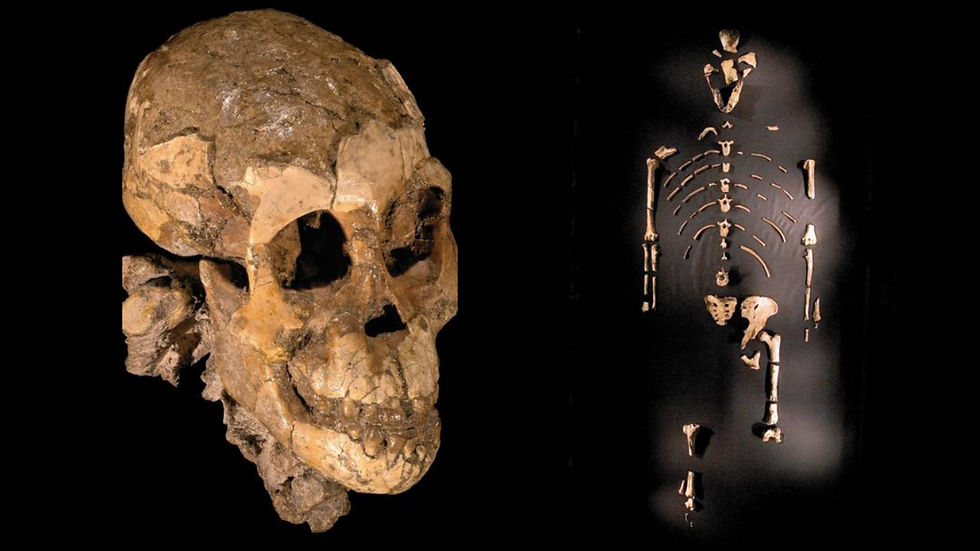
Donald Johanson, an avowed atheist, unearthed fragments that make up about 40% of what is claimed to be a single skeleton of Australopithecus afarensis, dated by evolutionary assumptions to 3.2 million years old. Johanson's worldview openly rejects God; he has stated, "I've always been an atheist. I didn't have to be converted to atheism." In interviews, he dismisses religious faith, aligning with naturalistic philosophy that excludes the Creator from the outset. This bias drives the interpretation of Lucy as a human ancestor, ignoring evidence that she was simply an ape. Johanson's atheism mirrors the broader evolutionary agenda, which presupposes no divine intervention, leading to forced conclusions that contradict Scripture.
Manipulations and Modifications: The Hip Bone Controversy
One of the most glaring issues with Lucy is the reconstruction of her pelvis. Evolutionists claim Lucy walked upright like humans, but the original hip bones were crushed and fragmented. To make her appear bipedal, researchers like Owen Lovejoy created a plaster replica, reshaping the damaged parts to resemble a human pelvis—short, bowl-shaped, and oriented for upright posture. Critics note that without these modifications, the pelvis suggests a more ape-like, quadrupedal gait. In extant apes, the hip bone is long, high, and narrow, facing forwards, while humans have a short, wrapped-around structure. This "repair job" was necessary to fit the evolutionary narrative, but it amounts to artistic license rather than objective science.
Scattered Bones and the Baboon Blunder: Not a Single Individual
Lucy's bones were not found in an articulated skeleton but scattered over a hillside, covering an area of about 1.5 miles and different stratigraphic layers. The knee joint, cited as evidence for upright walking, was discovered 200 feet lower and kilometers away from the main assemblage. This dispersion raises serious doubts: How can we be sure all bones belong to one individual? Biblical creationists argue they likely represent multiple animals, jumbled together in Flood sediments.
Compounding the problem, in 2015, researchers identified one of Lucy's vertebrae as belonging to an extinct baboon (Theropithecus darti), not a hominid. This bone, more weathered and textured differently from the rest, was mistakenly included for decades. Such errors highlight the unreliability of piecing together "ancestors" from fragmented remains, often contaminated by other species.

Discrediting Lucy as a Progenitor of Man
Lucy cannot be a progenitor of humanity. Her small brain (like a chimpanzee's), curved fingers and toes suited for tree-climbing, and overall ape-like anatomy confirm she was an extinct primate, not a transitional form. Even evolutionists admit Australopithecus afarensis should be on a side branch, not a direct ancestor. The Laetoli footprints, attributed to her kind, show human-like walking, but creationists see them as evidence of fully human prints from pre-Flood people. Lucy's promotion as our "ancestor" is a myth built on imagination, not facts.
The Biblical Truth: Creation Without Evolution
Scripture declares God created mankind in His image on Day 6, fully formed and without evolutionary precursors (Genesis 1:26-27). There was no death before Adam's sin (Romans 5:12; Genesis 1:31), as death entered through disobedience, not as a mechanism for "progress." Fossils like Lucy represent post-Fall death and burial during the Flood's judgment (Genesis 7-8), preserving creatures in sedimentary layers.
Evolutionary thought, rooted in atheism, biases fossil interpretation by assuming deep time and common descent, leading to fabrications like Lucy's "upright" posture. This worldview endangers souls by denying the Creator, promoting a godless universe where morality is relative, and undermining the gospel's foundation in a literal Adam and Fall. As Romans 1:20 warns, suppressing God's truth leaves men without excuse.
Conclusion: Stand Firm on Scripture
The Lucy fossil, far from proving evolution, exposes its deceptions. At The Flood Museum, we invite you to explore artifacts affirming biblical creation. Reject the myths; embrace the truth of God's Word for a foundation that endures.
Comments