

Ancient Persia, Modern Iran, and the Hope of Israel’s Restoration

We love opening the Scriptures and watching the same God who formed the earth in six days and preserved Noah through the global Flood continue to move through the pages of history. Few chapters of that history are more striking than the rise of ancient Persia. What God did through that empire long ago still speaks with power today, and the headlines of our own time only deepen our confidence that His Word remains true. We turn now to the prophetic picture, beginning with Persia itself and then moving carefully through the great oracle of Ezekiel 38 and 39.
Ancient Persia in the Biblical Record
The Bible introduces us to Persia at a moment of profound crisis for God’s people. After the Babylonian armies had destroyed Jerusalem and carried the remnant of Judah into exile, the Lord raised up a new power from the east, the Medo-Persian Empire, founded by Cyrus the Great.
More than a century and a half before Cyrus was born, the prophet Isaiah recorded these remarkable words:
“who says of Cyrus, ‘He is my shepherd, and he shall fulfill all my purpose’; saying of Jerusalem, ‘She shall be built,’ and of the temple, ‘Your foundation shall be laid.’” “Thus says the Lord to his anointed, to Cyrus, whose right hand I have grasped, to subdue nations before him…” (Isaiah 44:28–45:1)
God named a future pagan king and described the exact work He would assign him. When Cyrus conquered Babylon in 539 BC, he issued a decree that allowed the Jewish exiles to return home and rebuild the temple of the Lord (Ezra 1:1–4; 2 Chronicles 36:22–23). The sacred vessels that Nebuchadnezzar had carried away were restored, and the foundation of the second temple was laid. History and archaeology confirm these events, and the Cyrus Cylinder itself records the Persian king’s policy of allowing captive peoples to return and restore their places of worship.
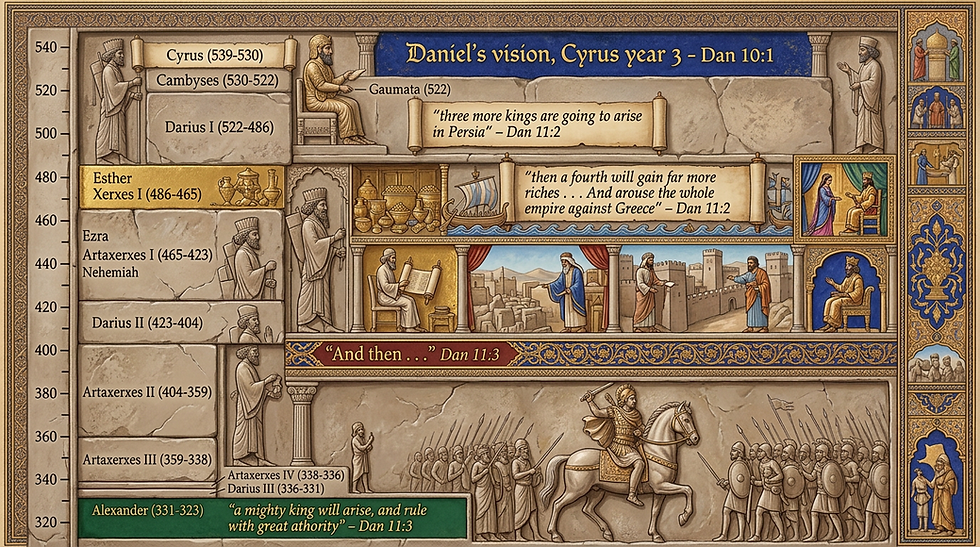
Daniel, who had served in the Babylonian court, continued under the new Persian administration. He rose to high office under Darius and lived into the reign of Cyrus (Daniel 6; 10:1). The book of Esther later places the Jewish people under the rule of Ahasuerus (Xerxes), showing both the dangers they faced and the remarkable deliverance God provided even in a foreign empire. Through it all, the consistent testimony of Scripture is that “the Most High rules the kingdom of men and gives it to whom he will” (Daniel 4:17, 25, 32).
In Daniel’s visions the Medo-Persian Empire appears as the silver chest and arms of Nebuchadnezzar’s statue (Daniel 2), the bear raised up on one side (Daniel 7), and the two-horned ram of Daniel 8 that is later broken by the goat representing Greece. Each image underscores the same truth: successive world powers rise and fall according to the timetable of the God of heaven, never by accident.
Most striking is the way the Lord used a non-Israelite ruler as His “anointed” and “shepherd.” Cyrus did not know the God of Israel in a personal covenant sense, yet God still directed his steps for the good of His people and the fulfillment of His promises. This reveals the sovereignty of the Creator. The same God who stretched out the heavens and established the foundations of the earth also directs the hearts of kings (Proverbs 21:1). Prophecy is not guesswork; it is the declaration of the One who “declares the end from the beginning” (Isaiah 46:10). The restoration under Cyrus prepared the historical stage for the later coming of the Messiah. Without a returned remnant, a rebuilt temple, and a preserved people in the land, the prophecies of the coming Redeemer would have lacked their setting. God’s faithfulness in the days of Persia became one more thread in the great tapestry that leads to Bethlehem, Calvary, and the empty tomb.
From Ancient Persia to Modern Iran
The ancient name “Persia” has never disappeared from the map. After centuries of successive empires, the heartland of that empire is known today as Iran. The people still carry the memory of Cyrus, and many Iranians take pride in their Persian heritage. Yet the spiritual climate has changed dramatically. Where once a Persian king facilitated the return of the Jews and the rebuilding of the temple, the modern Islamic Republic has positioned itself as a determined opponent of the restored nation of Israel.
The Bible traces enmity against the people of the covenant back to the serpent’s opposition in Genesis 3:15. Attacks on historic Israel are repeatedly linked to efforts to thwart God’s plan to bring the Messiah through that people and to fulfill His promises of restoration and blessing to the nations through them. Psalm 83 describes a coalition of surrounding peoples plotting, “Come, let us wipe them out as a nation; let the name of Israel be remembered no more.” Daniel 10 mentions a “prince of the kingdom of Persia” as a spiritual principality resisting God’s messenger, illustrating that national hostility can have unseen spiritual drivers beyond purely political calculation. In this reading, intense, persistent, and sometimes irrational commitment to Israel’s destruction can reflect opposition to God’s declared purposes, even when the actors themselves frame it in religious, nationalist, or anti-colonial terms.
Students of Scripture have long noticed that the prophet Ezekiel, writing during the Babylonian exile, named Persia among the nations that would one day join a great northern coalition against a restored Israel. The present tensions therefore invite careful attention to that oracle.
The Setting and Structure of Ezekiel 38–39
Ezekiel received these words while the people of Judah were still in exile. Chapters 33–37 have already promised restoration: the dry bones will live, the two sticks of Israel and Judah will become one, and the Lord will place His sanctuary among them forever. Immediately after that promise of national and spiritual renewal, the prophet is told to set his face against a future enemy.
The Lord identifies the leader and the coalition (38:1–6): Gog of the land of Magog, the chief prince of Meshech and Tubal, joined by Persia, Cush, and Put, all with shield and helmet; Gomer and all his hordes; and Beth-togarmah from the uttermost parts of the north with all his hordes—many peoples with him.
The motive and timing follow (38:7–16). After many days, in the latter years, this host will come against a people who have been gathered from the nations, who dwell securely in the land that had long been desolate, living without walls, bars, or gates. Their stated purpose is to seize spoil and plunder.
The Lord Himself is the One who brings them (38:4, 16; 39:2), putting hooks in their jaws. The invasion is not outside His sovereign plan. On the day Gog invades the land of Israel, the Lord’s fury rises. There is a great earthquake. Every man’s sword is against his brother. Pestilence, bloodshed, torrential rain, hailstones, fire, and brimstone are poured out (38:18–23; 39:1–6). The result is total defeat.
The aftermath occupies most of chapter 39. The weapons are burned for seven years. The dead are buried for seven months in a specially designated valley so that the land may be cleansed. Birds and beasts feast on the fallen. Then the nations know that the Lord is God, Israel knows that the Lord is their God from that day forward, and the Lord pours out His Spirit on the house of Israel and never again hides His face from them (39:21–29). The entire sequence ends with the recognition of Yahweh’s holiness and the restoration of His people under His open face. That is the theological heart of the passage.
Identifying the Players from the Ancient Sources
Every name in the coalition appears earlier in the Table of Nations (Genesis 10). Magog, Gomer, Meshech, and Tubal are sons of Japheth. Cush and Put are sons of Ham. Persia (Paras) belongs to the line of Shem through Elam. The coalition therefore draws from all three branches of Noah’s family, portraying a widespread revolt against the God of Israel.
Recent research on the human Y chromosome has suggested that the major paternal lineages of East Asian peoples, including the Chinese, also fall under the line of Shem. If this reading is correct, the Chinese people belong to the same broad Shemite stream. The point already present in Ezekiel is thereby strengthened: the opposition to God’s purposes for Israel is not limited to one branch of the human family. Humanity in its divided state stands against the Lord until He intervenes.
The geographic markers that best fit the ancient records are these:
Magog is linked by Josephus and other early writers with the Scythians, the nomadic peoples of the steppes north of the Black and Caspian Seas. That region stretches toward what we know today as southern Russia and Central Asia.
Meshech and Tubal appear repeatedly in Assyrian inscriptions as the Mushki (or Musku) and Tabal, peoples of central and eastern Anatolia, the heartland of modern Turkey.
Gomer corresponds to the Cimmerians (Assyrian Gimirrai), who moved into Anatolia in the eighth and seventh centuries BC.
Beth-togarmah is identified with Til-garimmu in the Armenian highlands, again in the eastern reaches of Anatolia or the area of ancient Armenia.
Persia is the clearest identification of all: the Achaemenid heartland that is modern Iran.
Cush points to the Upper Nile region (Sudan and parts of Ethiopia).
Put points to the North African coast, corresponding to Libya.

The repeated phrase “the uttermost parts of the north” (38:6, 15; 39:2) is decisive. From the vantage point of Israel, a line drawn due north passes through Anatolia and continues into the vast northern steppes. The core leadership is therefore northern and Anatolian, joined by Persia from the east and African allies from the south. The word rendered “Rosh” in some translations is best understood as “chief” or “head,” describing Gog as the chief prince of Meshech and Tubal rather than as a separate place name. What the text emphasizes is the far-northern origin of the leadership and the breadth of the coalition.
Connections to the Other Prophets and to John
Ezekiel himself tells us that this northern foe is not a new idea. In 38:17 the Lord asks, “Are you he of whom I spoke in former days by my servants the prophets of Israel, who prophesied for years that I would bring you against them?” The “foe from the north” is a recurring prophetic motif. Jeremiah repeatedly announces disaster coming from the north (Jeremiah 1:14–15; 4:6; 6:1, 22). Isaiah speaks of a nation from afar that will come with swiftness (Isaiah 5:26–30). These earlier oracles found historical fulfillments in Assyria and Babylon, yet Ezekiel presents Gog as the climactic realization of that pattern, an enemy still future to his own day.
Zechariah later describes a time when all the nations will gather against Jerusalem, the Lord will fight for His people, and the nations will recognize that the Lord is God (Zechariah 12:1–9; 14:1–5). Joel sees the nations assembled in the Valley of Jehoshaphat for judgment (Joel 3:1–16). Daniel’s visions of successive kingdoms and the final conflict (Daniel 2, 7, 11–12) supply the broader framework of empires that rise and fall until the stone cut without hands fills the earth. None of these passages is identical in every detail to Ezekiel 38–39, yet together they form a coherent prophetic tapestry: a final assault on the restored people of God, divine intervention, and universal recognition of the Lord’s sovereignty.
When we come to the Revelation given to John, the names Gog and Magog reappear after the thousand-year reign of Christ (Revelation 20:7–10). Satan is released, goes out to deceive the nations that are at the four corners of the earth (Gog and Magog), and gathers them for battle. Fire comes down from heaven and consumes them. The differences in timing and scope are clear. Ezekiel describes a specific northern coalition against a restored Israel, with a detailed cleanup of bodies and weapons. Revelation describes a universal rebellion after the millennium, led by Satan himself. John deliberately reuses the language of Ezekiel as a type of the final uprising against God and His people. The earlier feast of the birds in Revelation 19 also echoes the language of Ezekiel 39. Scripture therefore presents both a particular invasion associated with the restoration of Israel and a final, worldwide rebellion at the close of the age. Both testify to the same truth: the Lord will defend His people and display His glory among the nations.
Clarifying the Timeline with John’s Prophecy
A careful reading of Scripture keeps Ezekiel’s prophecy and John’s vision distinct while recognizing that the later apostle deliberately draws on the earlier language.
In Ezekiel 38–39 the invasion comes against a people who have already been gathered back to the land of Israel and are dwelling securely. The Lord Himself draws the northern coalition, defeats it with earthquake, internal confusion, and supernatural judgments, and then brings a detailed aftermath that includes the permanent turning of Israel to her God. From that day forward the Lord pours out His Spirit, never again hides His face, and Israel knows Him as their God. This includes the long-awaited national recognition of the Messiah. These events lead naturally into the restored sanctuary, the renewed land, and the open dwelling of God among His people that occupy the closing chapters of Ezekiel. In the flow of the book, the defeat of Gog and the spiritual awakening of Israel stand as the doorway into the blessings of the kingdom age.

John, writing centuries later, reuses the names “Gog and Magog” in Revelation 20:7–10, but he places them after the thousand-year reign of Christ. At that future point Satan is released from his prison, goes out to deceive the nations at the four corners of the earth, and gathers them for a final worldwide rebellion against “the camp of the saints and the beloved city.” Fire comes down from heaven and consumes them; then comes the final judgment and the new heaven and new earth. The scope is universal rather than focused on a northern coalition, the agent is Satan himself rather than a human prince, and there is no extended cleanup of bodies or weapons. John’s language shows that he saw in Ezekiel’s oracle a pattern of the ultimate hostility of the nations against God’s people and God’s decisive defense of them. He applies that pattern to the very last rebellion of history.

Thus the sequence of Ezekiel 38–39 (the invasion, the divine victory, the national recognition of Christ as Messiah, the outpouring of the Spirit, and the permanent open face of the Lord toward Israel) belongs to the restoration that prepares for and inaugurates the millennial blessings. John’s Gog and Magog stand at the far end of that same kingdom age, after the thousand years, as the final satanic uprising before the eternal state. Both passages testify to the same unchanging truth: the Lord will defend His people, display His glory, and bring every purpose of His Word to perfect completion.
How the Scriptures Inform the Events Unfolding Today
The restoration of Israel as a nation in the land, the open hostility of modern Iran (biblical Persia), the forming of strategic partnerships between Iran and powers to the north, and the persistent focus of regional conflict upon Jerusalem and the Jewish people all stand in striking consistency with the prophetic outline. The text of Ezekiel does not require us to declare that the full invasion is already underway. It does, however, describe a coalition in which Persia is a named participant, led from the far north, motivated by spoil, and directed against a people who have been gathered back to the mountains of Israel. The present alignment of nations, the deepening involvement of Iran against Israel, and the realignment of northern powers supply the kind of stage-setting that careful readers of Scripture have long anticipated.
China’s growing economic, diplomatic, and technological support for Iran, alongside Russia’s partnership with both, adds another layer to the picture. When a major eastern power stands with Persia and a northern power, the broader pattern of nations drawn from the dispersed family of Noah rising in pressure against Israel becomes more visible. Scripture never forces us to insert modern names into every detail, yet the alignment is consistent with the widespread character of the opposition the prophets describe.
When viewed through the longer biblical lens (from the serpent’s enmity in Genesis 3:15, through the plot of Psalm 83, to the spiritual principality mentioned in Daniel 10), the intensity of opposition to Israel takes on deeper significance. It is not merely geopolitical. It can reflect a deeper resistance to God’s declared purposes.
None of this produces fear for those who trust the Lord. The same God who named Cyrus before he was born, who raised up and brought down empires according to His purpose, and who preserved a remnant through exile is still on the throne. He has not abandoned His covenants. He has not lost control of the nations.
How It Will Play Out According to the Text
The Scriptures themselves tell us the outcome. The Lord will draw the coalition by putting hooks in their jaws. They will come for spoil against a people dwelling securely. On that day the Lord’s fury will rise. An earthquake will shake the land. Confusion will turn every man’s sword against his brother. Pestilence, blood, hail, fire, and brimstone will fall. The invaders will be completely defeated. Israel will spend months burying the dead and years burning the weapons. The nations will know that the Lord is God.
Then comes the heart of the promise. Israel will know that the Lord is their God from that day forward. The Lord will pour out His Spirit and will never again hide His face from them (Ezekiel 39:21–29). This is the long-awaited turning point the prophets foresaw, the moment when the veil is lifted and the nation truly recognizes her Messiah. Zechariah had spoken of a day when the Lord would pour out on the house of David and the inhabitants of Jerusalem a spirit of grace and pleas for mercy, so that they would look upon the One they had pierced and mourn for Him as one mourns for an only son (Zechariah 12:10). Paul later explained that a partial hardening has come upon Israel until the fullness of the Gentiles has come in, and then all Israel will be saved (Romans 11:25–27). The outpouring of the Spirit promised in Ezekiel is the same Spirit Joel described, the Spirit who brings genuine repentance and recognition of the Lord who was pierced for our transgressions. From that day forward the people of Israel will no longer stand at a distance. They will embrace their God in the person of the crucified and risen Messiah, Jesus Christ, and the Lord will never again hide His face from them. His dwelling among them will be open, permanent, and full of grace.
This sequence leads naturally into the blessings of the kingdom described in the chapters that follow: the restored sanctuary, the renewed land, and the presence of the Lord among His people forever. The prophecies concerning Persia (both the ancient ones already fulfilled under Cyrus and the future ones still unfolding) testify that His purposes cannot be thwarted.
Nation and Individual, Prophecy and Obedience
As we consider these things, it is important to distinguish between the history of a nation and the history of individuals. God rules over the rise and fall of kingdoms, yet He also works in the hearts of individual people. Cyrus himself stands as a clear example. The Lord called him by name, took him by the right hand, and used him as His shepherd and anointed instrument, even though Cyrus did not know the God of Israel in a personal covenant relationship. The same God who directed an entire empire also moved in the life of one man.
In the same way, the national posture of modern Iran does not define every person who lives within its borders. There are men and women in Iran today who sense the presence of God, who seek to follow Him, and who bear quiet and costly witness to the truth of Christ amid great difficulty. The Lord’s work among individuals continues even when the course of a nation appears set against His purposes. We must never confuse the prophetic trajectory of a kingdom with the personal story of every soul within it.
At the same time, knowledge of biblical prophecy is never a reason for passivity. It is a temptation to think, “God said these things would happen, so there is nothing I can do.” That attitude does not honor the Lord. Prophecy reveals what God will accomplish; it does not cancel the clear commands He has given His people in the present. Amos warned those who longed for the Day of the Lord without examining their own lives: “Woe to you who desire the day of the Lord! Why would you have the day of the Lord? It is darkness, and not light” (Amos 5:18). He called them instead to “seek good, and not evil, that you may live; and so the Lord, the God of hosts, will be with you” and to “let justice roll down like waters, and righteousness like an ever-flowing stream” (Amos 5:14, 24). Being found among the righteous matters on the day when God acts.
Scripture repeatedly calls God’s people to stand with Israel. The Lord said to Abraham, “I will bless those who bless you, and him who dishonors you I will curse, and in you all the families of the earth shall be blessed” (Genesis 12:3). The psalmist urges, “Pray for the peace of Jerusalem! May they be secure who love you!” (Psalm 122:6). The Lord declares that he who touches Israel “touches the apple of his eye” (Zechariah 2:8). Isaiah is told not to keep silent for Zion’s sake until her righteousness goes forth as brightness (Isaiah 62:1, 6–7). Paul reminds us that the gifts and the calling of God are irrevocable, and that Gentile believers are not to become arrogant toward the natural branches (Romans 11:18, 28–29).
Knowing that God will ultimately defend Israel and bring the nations to acknowledge Him does not free us from the duty to stand on His side now. We pray. We speak truth. We refuse to join the chorus that seeks Israel’s harm. We remember that the same God who rules the nations also searches the hearts of individuals, both in Iran and among His own people. Prophecy strengthens faith; it never excuses indifference.
A Word of Hope
As we study these things, our desire is never to stir anxiety but to strengthen faith. The God who judged the world by water in the days of Noah, who kept His people through the long centuries of empire after empire, and who brought them home under the decree of a Persian king is the same God who holds the future. The rising pressures in the Middle East, the open hostility of modern Persia toward Israel, and the realignment of global powers simply remind us that the Word of God is living and active. History continues to move toward the day when every knee will bow and every tongue confess that Jesus Christ is Lord.
These truths can deepen our confidence in Scripture, increase our love for the people of Israel, and turn our eyes toward the blessed hope of the return of our Lord Jesus Christ. The same hand that guided Cyrus is still guiding history, and that hand is good.

Comments