

The Grand Canyon

Updated: Aug 3
Echoes of the Flood
Application
The Grand Canyon is not a monument to millions of years of slow change. It is a testament to the global Flood of Noah’s day and to the hope we have in our faithful Creator and in the greater Ark, Jesus Christ.
In this Lesson
Dr. Bob shares a six-day rafting trip through the Grand Canyon on the Colorado River with guide Chris Wright and the team from Tour West, launching from Lee’s Ferry. From the river bottom the canyon’s layered sediments, fossils, trackways, the Great Unconformity, soft-sediment deformation, and rapid canyon carving all testify to catastrophic Flood processes rather than gradual erosion over deep time.
Seeing the Grand Canyon from the rim is impressive. It cuts through the desert like a living scar. It has fingers that reach out in every direction, searching for something. And it really likes to show off when the sun rises. There’s nothing quite like it. It’s truly unique in the world and brings visitors from far and wide.

It’s just unfortunate that there is so much confusion about its origin and what it means.
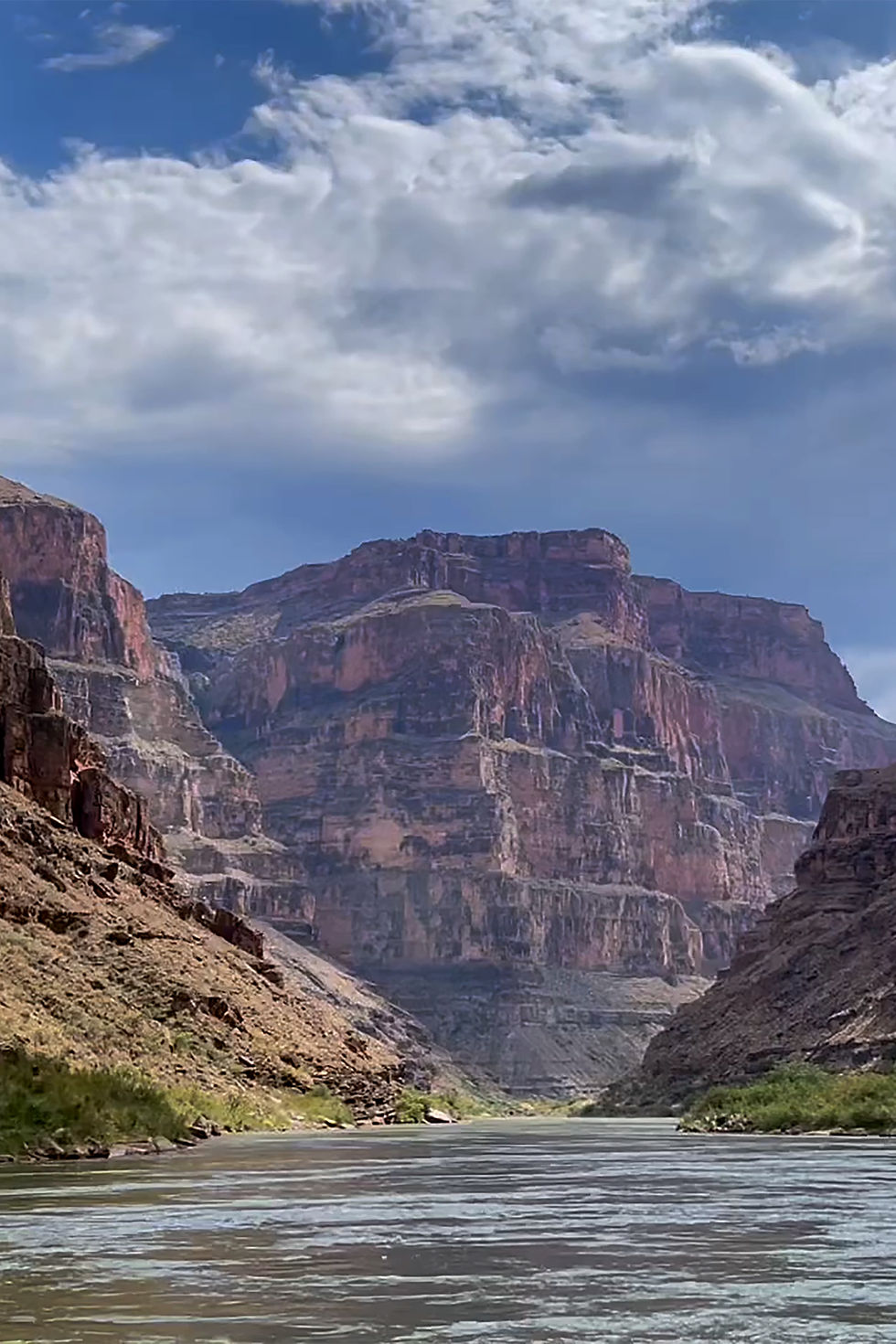
This wasn’t our first trip to the Grand Canyon, but it was our first fully immersive experience—six days on the Colorado River. Long enough to really listen and feel every splash, every rock, every sound, every bump, every minute. And it was a great opportunity to find the message in the rocks.
We launched at Lee’s Ferry with our outstanding guide, Chris Wright, and the wonderful team from Tour West. From the very first gentle bend in the river, the canyon began to teach us. At the bottom runs the Colorado River. This river gets a bum rap—it’s often blamed for carving all 277 miles of canyon. That’s not really the case, and just about everyone knows it. The Colorado drains an area of about 250,000 square miles, and in places the canyon is as much as 18 miles wide. Yet the modest river we rafted today is simply following the path of least resistance through a canyon already carved by the receding waters of Noah’s Flood.
The Bible tells the true story in Genesis 7 and 8. “In the six hundredth year of Noah’s life… all the fountains of the great deep broken up, and the windows of heaven were opened. And the rain was upon the earth forty days and forty nights.” The waters rose until every living thing that had the breath of life died—except those safe aboard the Ark. Then, in God’s mercy, “God remembered Noah… and the waters receded.” The land rose up, and the waters retreated (Psalm 104:8-9).
Every layer we floated past shouts that this was no local flood. It was global. Catastrophic. And the evidence is everywhere.
As we progressed through the canyon, we saw the beautifully banded layers of red, brown, tan, and occasional mauve—individual packages of sediment laid down wave after wave as the Flood waters rose and destroyed ecosystem after ecosystem. These layers contain large quantities of fossils—marine shells, land animals, and especially trace fossils. Look at the fossilized ripples in the Bright Angel Shale and Tapeats Sandstone. They measure only 15 to 20 degrees—consistent with underwater current ripples, not desert dunes that slope more than 25–32 degrees. Paleocurrent directions across these layers point consistently west to southwest on a continental scale, exactly what you’d expect from massive Flood water transport.
And the animal tracks! Thousands of footprints preserved in remarkable detail, many moving in the same direction as if the creatures were fleeing rising waters. We even saw well-preserved four-footed trackways in the Supai Group—animals apparently trying to escape. Footprints in mud don’t last long unless they’re buried quickly. These were captured by rapid pulses of Flood deposition. In the Tapeats Sandstone we also find abundant invertebrate trace fossils—trilobite tracks, burrows, and escape structures—along with massive numbers of nautiloid fossils. These aren’t the result of slow seafloor reworking; sharp contacts and scour-and-fill channels indicate high-energy, rapid burial during the early Flood surges.

One of the most striking features we encountered was the Great Unconformity. John Wesley Powell himself identified it in 1869. Here the Tapeats Sandstone sits directly on polished Precambrian granite. Deep-time geologists claim 1.2 billion years of rock are missing. But the Bible gives us the true story. At the onset of Noah’s Flood, 40 days of torrential rain and the breaking up of the fountains of the deep sent powerful cascades of water sweeping across the land. These early Flood tidal waves scoured the surface clean, polishing the basement rock like a gigantic sandblaster. Then the very first Flood sediments—the Tapeats—were laid right on top. This same Great Unconformity has been found on every continent. No missing time—just rapid, catastrophic erosion followed immediately by deposition, exactly as Scripture records. Between most layers we see almost no erosion surfaces, no soil horizons, and minimal deep burrowing—clear signs the sediments were laid down rapidly in succession.
We also saw dramatic waves and bends in the sediments—layers folded while still soft and flexible. In places like Carbon Canyon and along the East Kaibab Monocline, thick stacks of layers show tight folds, ridges, rotated blocks, and soft-sediment deformation structures. These rocks remained sedimentary, not metamorphosed, and show no fracturing that would occur if they had hardened first. They deformed plastically while still water-saturated—powerful evidence they were deposited quickly during the Flood and then bent by tectonic forces before they could harden.

When the land masses rose and the waters retreated, this area experienced a unique uplift—the Kaibab upwarp. The headwaters of the Colorado are about 12,000 feet high in the Rockies; by the time it reaches the Grand Canyon it’s around 5,000 feet. The North Rim itself sits over 8,000 feet. Water doesn’t carve uphill! Instead, the rising land dammed up enormous post-Flood lakes. When those dams breached, massive volumes of water—augmented by melting ice from the post-Flood Ice Age—rushed through with incredible force. Cavitation bubbles acted like underwater jackhammers, shattering rock on contact. We saw a small-scale version in 1983 at Glen Canyon Dam, where spillway water carved a huge hole through reinforced concrete and bedrock in a very short time. The essential features of the canyon were cut very rapidly—in days and weeks—not millions of years.

In the midst of all this power, we also saw the beauty of God’s provision. Majestic bighorn sheep standing sure-footed on the cliffs remind us that after the Flood God commanded the animals to “be fruitful and multiply and fill the earth” (Genesis 9:1). Every creature is a living testimony of His care.
This was an amazing opportunity to view this wonder from the bottom up. Without the help of our guide Chris Wright and everyone at Tour West, we wouldn’t have been able to witness these things. It was an experience of a lifetime.

Friends, as our raft drifted through the final calm stretches, the message in the rocks was unmistakable. The rising rapids spoke of the power of the Flood. The sediment layers, fossils, trackways, ripples, and soft-sediment deformation declared the rapid deposition and burial during that catastrophic year. The Great Unconformity and bent sediments showed us the sudden scouring and plastic deformation while the rocks were still soft. The rapid carving of the canyon itself testifies that the receding Flood waters did their work quickly.
The Grand Canyon is not a monument to millions of years of slow change. It is a monument to the global Flood of Noah’s day—and to the hope we have in our faithful Creator. Just as God provided the Ark to save Noah and his family, He has provided a greater Ark for us today in the person of His Son, Jesus Christ.
Every splash, every rock, every layer points back to the truth of God’s Word. The heavens declare His glory, and so does this canyon. It’s OK to believe.
Thank you for joining me on this journey. Keep studying the evidence—it all testifies of God.

Scripture References
Genesis 7:11–12 “In the six hundredth year of Noah’s life, in the second month, the seventeenth day of the month, the same day were all the fountains of the great deep broken up, and the windows of heaven were opened. And the rain was upon the earth forty days and forty nights.”
Genesis 8:1–3 “And God remembered Noah, and every living thing, and all the cattle that was with him in the ark: and God made a wind to pass over the earth, and the waters asswaged; The fountains also of the deep and the windows of heaven were stopped, and the rain from heaven was restrained; And the waters returned from off the earth continually: and after the end of the hundred and fifty days the waters were abated.”
Genesis 9:1 “And God blessed Noah and his sons, and said unto them, Be fruitful, and multiply, and replenish the earth.”
2 Peter 3:4 “And saying, Where is the promise of his coming? for since the fathers fell asleep, all things continue as they were from the beginning of the creation.”
Psalm 19:1 “The heavens declare the glory of God; and the firmament sheweth his handywork.”


Comments