

I Am Doing a Great Work and Cannot Come Down

Lessons from the Temple in Jerusalem, Cyrus, and Nehemiah
The history of the Temple in Jerusalem offers a powerful window into how the Lord works among His children. It begins with Solomon’s Temple, the First Temple. Construction began in the fourth year of Solomon’s reign, around 966–957 BC, and the house of the Lord was completed in seven and one-half years. This magnificent structure stood as a center of worship and covenant until the Babylonians destroyed it in 586 BC.

After seventy years of exile, the Lord stirred the heart of a Persian king to reverse the captivity. In 539/538 BC, Cyrus issued a decree allowing the Jews to return to Jerusalem and rebuild the house of God. He even restored the temple vessels taken by Nebuchadnezzar and provided resources for the work. The foundation of the Second Temple was laid under Zerubbabel soon after the return, and the temple was completed and dedicated about 516 BC. Centuries later, Herod the Great began a major expansion of the Temple complex around 20 BC. That structure stood until the Romans destroyed it in AD 70.
Cyrus stands as a striking example of a principle that runs through all of scripture and history. The Lord had named him by name through the prophet Isaiah more than a century before his birth, calling him “my shepherd” and “his anointed” who would declare that Jerusalem should be built and the temple foundation laid (Isaiah 44:28; 45:1). A pagan emperor became an instrument in the Lord’s hands. As Elder Ezra Taft Benson taught, “God, the Father of us all, uses the men of the earth, especially good men, to accomplish his purposes. It has been true in the past, it is true today, it will be true in the future.” The Lord can turn the hearts of kings and use people both inside and outside the covenant community to further His work.
This same divine pattern appears again in the days of Nehemiah. Nearly a century after the Second Temple was completed, the walls of Jerusalem still lay in ruins. Nehemiah, cupbearer to the Persian king Artaxerxes, learned of the broken walls and burned gates. With the king’s permission he traveled to Jerusalem, surveyed the damage by night, and rallied the people. Despite mockery, threats, and internal hardships, “the people had a mind to work” (Nehemiah 4:6). The wall rose rapidly.
In the ancient Near East, city walls were far more than stone and timber. They formed the essential defensive boundary that allowed a people to live in security. Without walls, a city remained exposed to raiders, hostile neighbors, and sudden attack. For post-exilic Jerusalem, the absence of walls meant that the newly rebuilt Temple and the returning remnant stood unprotected. Families could not dwell in safety. The sacred ordinances of the house of the Lord remained vulnerable. A city without walls was incomplete and, in the eyes of surrounding peoples, a place of shame and weakness. Scripture repeatedly underscores this reality. When Nehemiah first heard the report, he learned that “the wall of Jerusalem also is broken down, and the gates thereof are burned with fire” (Nehemiah 1:3). Later he challenged the people, “Ye see the distress that we are in, how Jerusalem lieth waste, and the gates thereof are burned with fire: come, and let us build up the wall of Jerusalem, that we be no more a reproach” (Nehemiah 2:17). The psalmist prayed, “Do good in thy good pleasure unto Zion: build thou the walls of Jerusalem” (Psalm 51:18). Isaiah prophesied of a future day when “thou shalt call thy walls Salvation, and thy gates Praise” (Isaiah 60:18), and the Lord declared through Zechariah, “For I, saith the Lord, will be unto her a wall of fire round about, and will be the glory in the midst of her” (Zechariah 2:5). Rebuilding the walls therefore restored not only physical protection but also national dignity, covenant identity, and the practical ability to live as a holy people before God. The walls created a secure space in which the law could be taught, the Sabbath observed, and the Temple properly honored. In short, the walls made possible the future of Israel as a covenant community.
When the breaches were nearly closed and only the doors remained to be set in the gates, the enemies intensified their efforts. Sanballat, Tobiah, Geshem the Arab, and others invited Nehemiah four times to meet them in the plain of Ono, a distant and vulnerable location. Their intent was not friendship but mischief. Each time Nehemiah answered with the same clear words: “I am doing a great work, so that I cannot come down: why should the work cease, whilst I leave it, and come down to you?” (Nehemiah 6:3).
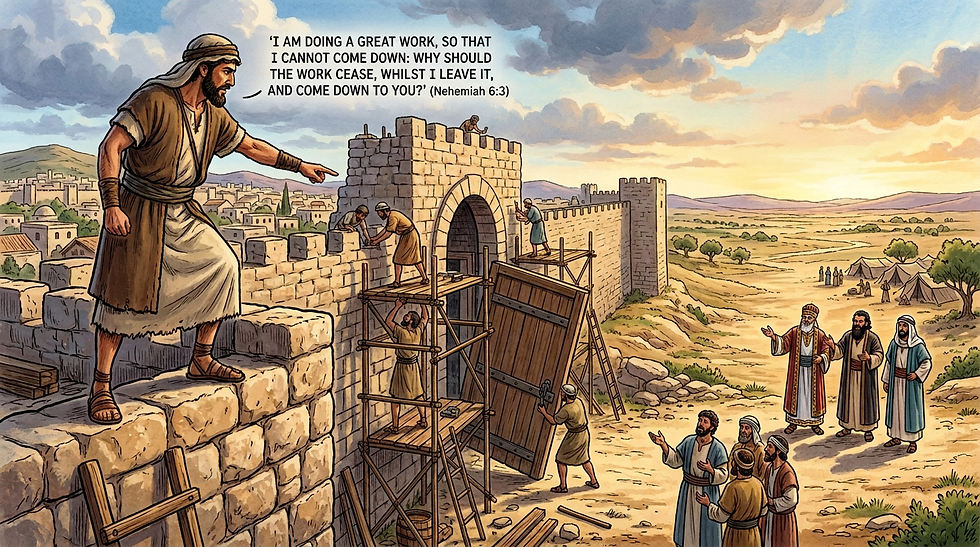
In the original Hebrew the phrase “a great work” is mĕlāʾḵâ gĕdôlâ. Mĕlāʾḵâ refers to work, occupation, or ministry, often carrying the sense of an appointed or sacred task. Gĕdôlâ underscores its magnitude and importance. The verb “come down” (yārad) is both literal and figurative. It means descending from the wall or from Jerusalem, yet it also suggests leaving a higher calling or position of focused responsibility. Nehemiah refused to allow the sacred work to cease.
When the open invitation failed, the enemies sent an unsealed letter filled with false accusations of rebellion and ambition. Nehemiah simply replied that the claims were invented out of their own hearts. Still later, they hired a false prophet to urge Nehemiah to flee into the temple and shut the doors for safety. Such an act would have been a sin for Nehemiah, who was not a priest, and would have given the enemies grounds to reproach him. Nehemiah discerned the deception and refused. The wall was finished in fifty-two days, and the enemies recognized that “this work was wrought of our God” (Nehemiah 6:16).
The pattern of opposition in Nehemiah 6 remains familiar in every age. The adversary still invites us to leave the Lord’s work under the guise of friendship, reasonable negotiation, or wise self-preservation. He presents attractive alternatives that appear harmless or even beneficial, yet their true purpose is to pull us away from the sacred task the Lord has given us. He spreads open falsehood through rumor, accusation, and distorted information designed to create fear, doubt, and division among those who are trying to build. Most cunning of all, he uses religious-sounding voices, including well-meaning but misguided counsel or even false spiritual impressions, to lure the faithful into compromise. These invitations often come at the very moment when the work is advancing and the walls of faith, family, or covenant are nearly complete. The goal is always the same: to cause us to step down from the high ground of focused discipleship so that the work itself is delayed, weakened, or discredited. Recognizing this pattern helps us answer as Nehemiah did, refusing to come down.
Satan understands that strong spiritual defenses protect us now and prepare us for the future. Just as Jerusalem’s walls guarded the Temple and the people against physical enemies, the spiritual walls we build today guard our homes, our covenants, and the rising generation against the increasing pressures of the last days. Scripture itself draws this parallel: “He that hath no rule over his own spirit is like a city that is broken down, and without walls” (Proverbs 25:28). Just as the walls of Jerusalem created a secure boundary that protected the Temple, the people, and the possibility of covenant life, the spiritual walls we carefully build today form a living defense around our families and our faith. Through daily prayer, consistent scripture study, regular temple worship, family councils, and the quiet keeping of covenants, we raise barriers against the adversary’s constant invitations to come down from the work. These walls do not isolate us from the world; rather, they create a sacred space in which faith can grow strong, children can be taught truth without constant interruption, and the Spirit can dwell unhindered. When we refuse distractions and continue building, even when the work feels slow or the opposition subtle, we prepare a place of safety that will protect those we love in the days ahead, just as Nehemiah’s completed walls once allowed Jerusalem to stand secure before the Lord. The adversary therefore works diligently to keep us from constructing those defenses. He distracts us with endless demands on our time and attention. He deceives us into thinking that small compromises will not matter or that the work of strengthening our families and personal discipleship can wait until conditions improve. He frequently uses other people, sometimes friends, relatives, or respected voices, to voice the invitation to “come down” from the wall. Their words may sound reasonable, loving, or even spiritual, yet the effect is the same: the building stops, the gaps remain, and the protection that would have shielded us in coming days is never finished.
President Dieter F. Uchtdorf taught this principle with clarity in his April 2009 general conference address. After recounting Nehemiah’s repeated refusals, he declared:
“What a remarkable response! With that clear and unchanging purpose of heart and mind, with that great resolve, the walls of Jerusalem rose until they were rebuilt in an astonishing 52 days. Nehemiah refused to allow distractions to prevent him from doing what the Lord wanted him to do.”
He then applied the lesson directly to us:
“It is easy to become distracted… But think of the power we would have as individuals and as a body of the priesthood if, in response to every temptation to lose focus or lower our standards—the standards of God, we responded, ‘I am doing a great work and cannot come down.’ … The Lord is seeking men like Nehemiah… those who, when faced with opposition and temptation, say in their hearts, ‘I am doing a great work and cannot come down.’ When faced with trial and suffering, they respond, ‘I am doing a great work and cannot come down.’ When faced with ridicule and reproach, they proclaim, ‘I am doing a great work and cannot come down.’”
We see this principle at work in our own day with the renovation of the Salt Lake Temple. Dedicated in 1893 after decades of pioneer sacrifice, the temple is being strengthened with a base isolation system, preserved in its historic beauty, and prepared for greater capacity and accessibility. As of mid-2026 the seismic work is complete, the historic east doors have been reinstalled, and finishing continues toward a projected 2027 open house. The project itself illustrates the Lord’s pattern of using skilled hands, many of whom may not share our faith, to accomplish sacred purposes. At the same time, modern Saints face the same invitations Nehemiah faced: distractions, criticisms, delays, and competing priorities that would pull us away from covenant keeping, temple worship, family history, and the building of Zion. The answer remains the same. We are doing a great work and cannot come down.

The walls of Jerusalem mattered because they protected the people and the house of the Lord so that covenant life could continue into the future. In the same way, the spiritual walls we raise today through consistent prayer, scripture study, temple attendance, family unity, and faithful obedience will protect us and those we love in the days ahead. The adversary knows this. That is why he works so hard, often through the voices of others, to distract and deceive us before the defenses are complete. The Lord has always advanced His purposes through willing instruments, whether a Persian king named in prophecy, a cupbearer who refused to leave the wall, or ordinary disciples who stay focused on the work of the last days. The walls of Jerusalem rose because the people had a mind to work and a leader who would not come down. The Salt Lake Temple stands stronger today because the same determined spirit continues. We can each answer the invitations of the adversary with Nehemiah’s clear resolve and remain steadfast in the great work the Lord has placed in our hands, building the defenses that will protect us now and in the future.


Comments