

Meteorites, Echoes of the Fall

(This discussion introduces a theory developed by Dr. Wright. While it has involved significant research and time, it is a work in progress. It is the result of an effort to recognize God's creative work in the world around us. This will be presented in several installments and will be an ongoing discussion,)
Meteorites are intriguing artifacts. We have several specimens at The Flood Museum, and always wonder what they tell us about creation and the fall. Like fossils, they are often used as evidence of alternate theories of creation. They are supposed to be billions of years old, and used as "evidence" to disprove the creation narrative God provided in Genesis. It was with these thoughts in mind, and years of pondering the evidence (versus the conclusions), that led to this proposed theory. It combines research on Noah's migration routes, the discovery of ancient sites like Göbekli Tepe, their advance technology, ancient timekeeping, the scriptural record of signs and seasons, and the nature of God's perfect creation, corrupted by the fall. It is presented here not as absolute fact, but as an exercise in evaluating all the evidence, the catastrophic effects of the fall, and embracing God's creative power to turn all things to His purpose.

Proposed Theory: Catastrophic Destruction of a Day 4 Planet (“Rahab”) Producing the Asteroid Belt and Meteorites, Coupled with Rotational Slowing, Year-Length Changes, and Rapid Post-Flood Axial Reorientation via True Polar Wander (TPW) or Obliquity Shift
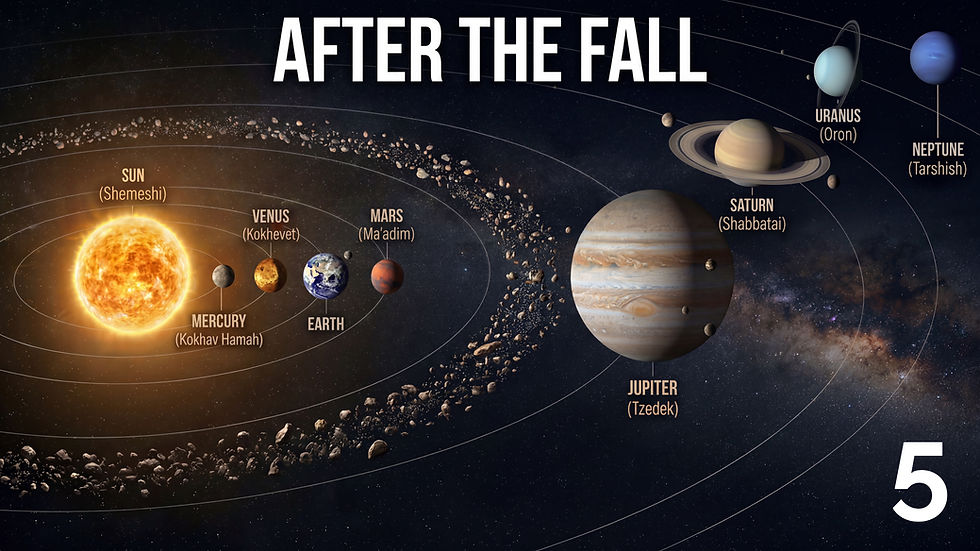
In a biblically consistent young-Earth framework (Genesis 1:1-19), God created the sun, moon, stars, and all other heavenly bodies, including the planets of our solar system, on Day 4 as part of a “very good” cosmos (Genesis 1:31). This included a terrestrial planet (hypothetically positioned roughly between the orbits of Mars and Jupiter, consistent with Titius-Bode law spacing). Call this planet “Rahab,” drawing on poetic biblical language in Psalm 89:10, Isaiah 51:9, and Job 9:13, where Rahab symbolizes a defeated chaotic power crushed by God (some independent interpreters have applied it cosmically, though others link it to Egypt or sea-dragon motifs of chaos).

This planet was formed with a rocky/iron composition, stable orbit, and sufficient mass for differentiation (core, mantle, crust) under God’s direct creative act. After Creation Week, likely triggered as part of the broader curse on creation following the Fall (Genesis 3:17-19; Romans 8:20-22) or a pre-Flood angelic judgment (2 Peter 2:4; Jude 6), God permitted or directly initiated its catastrophic destruction through natural physical processes He upholds (Colossians 1:17; Hebrews 1:3).

Scientifically supportable mechanism for asteroid/meteorite formation
The planet approached too close to massive Jupiter (or experienced gravitational instability). Tidal forces exceeded its Roche limit, gravitationally shredding it. Internal heating or a massive impactor could have added explosive disruption.

Conservation of mass and momentum: Most material was ejected from the solar system, accreted onto other bodies (e.g., contributing to lunar highlands or Martian features), or vaporized. Only a tiny remnant remained as fragmented asteroids, explaining the belt’s low total mass (about 0.0006 Earth masses). Ongoing collisions in the belt (Kirkwood gaps, Jupiter resonances) produce meteoroids that intersect Earth’s orbit as meteorites.
Compositions match: Iron, stony, and chondritic meteorites reflect core/mantle/crust fragments formed rapidly under catastrophic conditions, not slow nebular accretion.

Tie to lengthening of Earth’s year via slowing rotation
Earth’s sidereal orbital year is gravitationally stable, but the solar day lengthens due to tidal friction. In this model, the Rahab disruption produced a close gravitational flyby or asymmetric debris swarm passage near Earth. Tidal torques and/or oblique low-velocity impacts transferred angular momentum from Earth’s spin to the orbital system: Earth’s rotation slowed (consistent with observed tidal lengthening of the day, extrapolated rapidly backward).
This “lengthened the Earth year” practically: Pre-event calendars (360 days) shifted as days lengthened. Orbital perturbations from the debris cloud could have slightly increased Earth’s semi-major axis, lengthening the orbital period modestly on a biblical timescale. Angular momentum is conserved across the interacting bodies.
Rapid change in Earth’s axial precession through true polar wander (TPW) or obliquity shift, accounting for post-Flood archeoastronomical alignments
The Rahab debris impacts were not evenly distributed. Asymmetric mass redistribution onto Earth’s crust and disturbances in the mantle shifted the planet’s principal axis of inertia relative to its spin axis. In response, the solid Earth underwent true polar wander (TPW), a reorientation of the crust and mantle as a unit to bring the maximum inertia axis back into alignment with the rotation axis. TPW is a recognized geophysical process observed and modeled on other planets and moons. The sudden loading from large-scale impacts supplies the torque required for such a shift, similar to major reorientation events studied in planetary science.
Simultaneously, the axial tilt (obliquity) could have changed due to the same forces. This altered the orientation of Earth’s spin axis relative to the background stars and the planet’s surface. The celestial pole shifted to a new position among the constellations, and precession afterward followed a modified rate or path as the system stabilized. The underlying physics holds: angular momentum and the moment of inertia are conserved, with impact energy converted into rotational adjustments, heat, and geologic activity. All of this could have taken place within the Flood year and the immediate post-Flood recovery period without violating physical laws.
Integration with Noah’s Global Flood (approximately 2348 BC)
The main fragmentation of Rahab and the delivery of its debris swarm occurred at the onset of the Flood, forming part of the same divine judgment (Genesis 6:5-7, 11-13, and 2 Peter 3:5-6). The impacts helped fracture Earth’s crust, contributing to the bursting of the “fountains of the great deep” described in Genesis 7:11. They also intensified volcanic activity and generated massive tsunamis, amplifying the scale of the Flood. Evidence consistent with this includes fossil meteorites found in Flood-deposited sediments and the pattern of lunar craters showing an early light episode followed by a heavy swarm. The same transfer of angular momentum that slowed Earth’s rotation also triggered the TPW and obliquity changes during the Flood year.
A notable aspect of this model is that many of the Rahab-derived meteorites and smaller debris entered Earth’s atmosphere and struck the surface while the planet was already covered by the rising Flood waters. In a purely naturalistic scenario, such a bombardment could have delivered devastating energy capable of shattering the crust beyond recovery or boiling away large volumes of water. However, the impacts occurred in the presence of deep, global floodwaters that acted as a cushioning buffer. The water absorbed and dissipated much of the kinetic energy from the strikes, reducing direct shock to the underlying crust and limiting secondary effects such as widespread vaporization or excessive fracturing that might have destabilized the planet’s overall physical integrity. This allowed the Flood to accomplish God’s judgment through controlled crustal breakup and tectonic activity while preserving the structural framework of the Earth itself. God can modulate catastrophic events to achieve His purposes, and the timing of these meteorite strikes amid the Flood waters aligns with that protective oversight, ensuring the planet remained habitable enough for the post-Flood world.

Post-Flood archeoastronomical implications, including sites such as Göbekli Tepe
In the biblical timeline, Göbekli Tepe and similar early post-Flood megalithic structures were constructed not long after the waters receded. The builders were descendants of those who left the Ark and retained advanced knowledge from the pre-Flood world (Genesis 10-11). Archeoastronomical studies show that central pillars in several enclosures align toward the setting point of Deneb in the constellation Cygnus. Certain carvings, such as those on Pillar 43 (known as the Vulture Stone), appear to depict constellations in relation to the summer solstice and suggest awareness of lunisolar cycles. Uniformitarian interpretations mistakenly date these features to around 10,950 BC based on their understanding of precession.

In the proposed model, the alignments do not require thousands of years of gradual precession. The TPW and obliquity shift reoriented the sky as seen from Earth’s surface. Immediately afterward, the celestial pole pointed toward different stars, making regions such as Deneb and Cygnus especially prominent. The builders aligned their structures with this newly configured sky. They tracked the shifted pole stars, adjusted solstice positions, and observed the beginning of precessional drift as Earth stabilized. What appear as reorientations or discrepancies with modern alignments simply reflect the transitional sky following the catastrophe. Over the following centuries, as precession continued (and slowly began to decrease) under the new conditions, later structures or modifications show progressive adjustments. This explanation aligns with patterns seen at many ancient megalithic sites worldwide when Flood-related effects on dating methods and rapid post-Flood changes are taken into account.
This theory integrates smoothly with the entire biblical account:
On Day 4, Rahab was created perfect (Genesis 1:14-19).
Between the Fall and the Flood, instability grew under the curse, but the complete destruction was reserved for the time of judgment.
During the Flood year (Genesis 7-8), the impacts, crustal fracturing, slowing of rotation, and axial reorientation all functioned as instruments of God’s wrath while He preserved Noah. The post-Flood promise of stable seasons (Genesis 8:22) remains valid in the new configuration.
In the period following the Flood, during the days of Babel and Peleg (Genesis 10:25 and 11), the “division of the earth” may have included these changes in the sky and axis along with the dispersion of peoples and languages. Early descendants recorded the new heavens in structures such as Göbekli Tepe, using them as memorials or calendars.
In later biblical history from the Exodus onward, Earth’s rotation and precession stabilized. Remnant meteorites continue to fall as “falling stars,” serving as prophetic reminders of future judgment (Matthew 24:29 and Revelation 6:13). All of this directs attention to Jesus Christ, who sustains the universe (Colossians 1:17) and will one day create a new heavens and new earth with no more curse (Revelation 21:1).
The model is hypothetical, yet it is grounded in established physical principles such as the Roche limit for planetary disruption, impact-generated torques, conservation of angular momentum, the dynamics of true polar wander, and orbital resonances. It provides a unified way to understand asteroid and meteorite characteristics, changes in Earth’s spin, Flood geology, and the archeoastronomical features of ancient sites. Rather than relying on a slow nebular origin over billions of years or uniformitarian precession over long ages, this view centers on a single, God-timed catastrophe recorded in Scripture. In doing so, it highlights God’s complete sovereignty over His creation, including His ability to direct even destructive forces in ways that fulfill His purposes while maintaining the Earth’s essential stability.
Interesting Corroborations from Ancient Traditions
Elements of this theory find intriguing thematic echoes in ancient traditions and myths, which some view as distorted cultural memories of a real cosmic catastrophe involving a disrupted heavenly body, falling debris, and a global deluge. These parallels serve as interesting corroborations rather than direct confirmations, highlighting how widely humanity has preserved echoes of cataclysmic events that align with the biblical account of judgment and renewal.
Jewish tradition includes dramatic auditory phenomena at the onset of Noah’s flood. Narrative accounts portray a terrifying combination of thunder, lightning, earthquake-like shaking, and an unprecedented "very loud sound" heard across the entire world as the flood begins.
Talmud Rosh Hashanah 11b (and parallels in Seder Olam) states that God altered the natural order by causing the constellation Kima (Pleiades) to rise instead of set, and removed two stars from it to bring the flood. This is presented as a deliberate celestial act that opened the "windows of heaven" and unleashed the waters. Later interpretations (e.g., by Ramban/Nachmanides) describe God taking these stars and "throwing them at the earth" to initiate the deluge.
In Mesopotamian mythology, particularly the Enuma Elish, the chaos goddess Tiamat (a dragon-like sea monster embodying primordial waters) is slain by the god Marduk. Her body is split to form the heavens and Earth, with rivers flowing from her eyes in some accounts. Biblical scholars note that the Hebrew term “Rahab” (and related sea-dragon imagery like Leviathan or tehom for the “deep”) shares conceptual overlap with Tiamat as a symbol of chaotic waters defeated by the Creator. While the Bible presents God’s victory as effortless and sovereign (no true battle among equals), some independent voices have drawn literal connections, suggesting the asteroid belt as remnants of a shattered “Rahab” or Tiamat-like body whose fragments contributed to earthly upheaval.
The Greek myth of Phaethon, son of the sun god Helios, who disastrously drives the solar chariot, scorching the Earth before being struck down by Zeus, has also been linked by some to celestial disruption and falling bodies. The hypothetical destroyed planet between Mars and Jupiter was historically named Phaethon, partly due to this association. The story evokes themes of heavenly disorder, fire from the sky, and resulting floods or chaos.
Broader global flood stories (documented in hundreds of cultures) frequently include cosmic signs such as “stars falling like rain,” fire from heaven, darkened skies, or shifts in the celestial order accompanying a world-ending deluge. Indigenous traditions in the Americas, for example, describe the sky exploding or stars raining down before massive floods that reset the world. These motifs parallel the theory’s debris swarm delivering impacts amid Flood waters, rotational and axial changes, and the practical lengthening of the year through disrupted celestial mechanics.
Such ancient traditions capture a shared cultural memory of cosmic catastrophe involving disrupted heavenly bodies, falling debris (“falling stars”), and a deluge that reshapes the Earth and sky. The Rahab model offers a framework that could interpret these accounts as faded recollections of the biblical Flood judgment, where God used created elements (including Rahab’s remnants) as instruments of wrath while sovereignly preserving the planet’s integrity through the buffering Flood waters and ultimately promising stable seasons afterward (Genesis 8:22). However, pagan myths typically feature warring gods or heroic figures rather than the one true Creator acting in righteous judgment on human sin while saving a remnant through Noah. The resonances are thematic and cultural rather than precise historical matches, underscoring how the biblical record provides the clearest theological foundation. As is so often the case, these corroborations from ancient traditions are frequently the remnants of knowledge originally known through divine revelation (passed down from Noah and his family after the Flood), that were later corrupted by the world as humanity turned away from the true God.
Authors Note:
You might have heard about the Murchison meteorite that fell in Australia back in 1969 and the Jbilet Winselwan meteorite from Western Sahara. Both are carbonaceous chondrites, and scientists have found all sorts of amino acids in them. The Murchison one, in particular, has more than 70 different amino acids, including many that are not even used in Earth life. Some people point to these and say meteorites could have delivered the “building blocks of life” to Earth.

Here is the thing: “organic compounds” just means carbon-based molecules. In chemistry, that label covers everything from simple methane gas to complex tars and oils. It does not mean the compounds are alive or even biological. Living things use very specific, highly organized biological compounds, but the organics in these meteorites are mostly a messy mix of non-biological chemicals formed through ordinary physical and chemical processes in space.

That leads to some big challenges if you are hoping these meteorites supplied ready-made ingredients for life. The amino acids are present only in tiny amounts and are mixed in with a lot of other useless stuff. Even more important is the handedness problem. Life on Earth needs almost exclusively left-handed (L-form) amino acids to build working proteins. DNA and RNA, on the other hand, require right-handed (D-form) sugars. In the Murchison and Jbilet Winselwan meteorites, the amino acids are mostly racemic, basically a 50/50 mix of left- and right-handed forms, or they show only very small excesses of one hand (usually under 20% for a few unusual amino acids). A random mixture like that simply will not produce functional proteins; the chains get jumbled and do not fold properly. There is no known natural process that can take such a tiny imbalance and turn it into the complete one-handed purity life demands, especially in the chaotic conditions of a young Earth or during the global Flood.

These meteorites do show that carbon-based molecules can form in space through ordinary chemistry, but they fall far short of explaining how life could arise from non-life. Instead, they remind us just how much precise information and specificity are required for living systems, something that points strongly to the intentional design and creative work of God described in Genesis rather than random chemical accidents.


Comments