

The Shroud of Turin

Updated: Mar 4
Scientific Evidence Confirms Its Authenticity as the Burial Cloth of Jesus
We are excited to include a museum quality replica of the Shroud of Turin in our exhibit, as well as artifacts that confirm its authenticity, and testify of the events of Christ's crucifixion, and resurrection.

For centuries, the Shroud of Turin—a 14-foot linen cloth bearing the faint, full-body image of a crucified man—has captivated believers and skeptics alike. Long revered as the burial shroud of Jesus Christ, the relic has been the subject of intense scrutiny. Yet mounting forensic, botanical, numismatic, and archaeological evidence now overwhelmingly confirms its 1st-century origin in Jerusalem and its direct connection to the Passion narrative.
One of the most compelling lines of proof comes from pollen analysis. In 1978, Swiss criminologist Max Frei collected samples from the Shroud and identified 58 distinct pollen types. Subsequent studies by Israeli botanist Avinoam Danin of the Hebrew University of Jerusalem in 1999 pinpointed high concentrations of pollen from plants such as Gundelia tournefortii (a thistle), Cistus creticus, and Zygophyllum, species that bloom only in March and April in the Jerusalem region. These pollens far outnumber any European varieties and could not have been wind-transported across the Mediterranean due to prevailing wind patterns and blooming seasons. Additional grains match the Shroud’s documented historical path: species unique to ancient Edessa (modern Urfa, Turkey) and Constantinople (Istanbul) align precisely with its journey from Jerusalem through the Byzantine world before reaching Europe in the 14th century. This pollen trail irrefutably places the cloth in Jerusalem at the time of Jesus’ burial and confirms its subsequent travels.
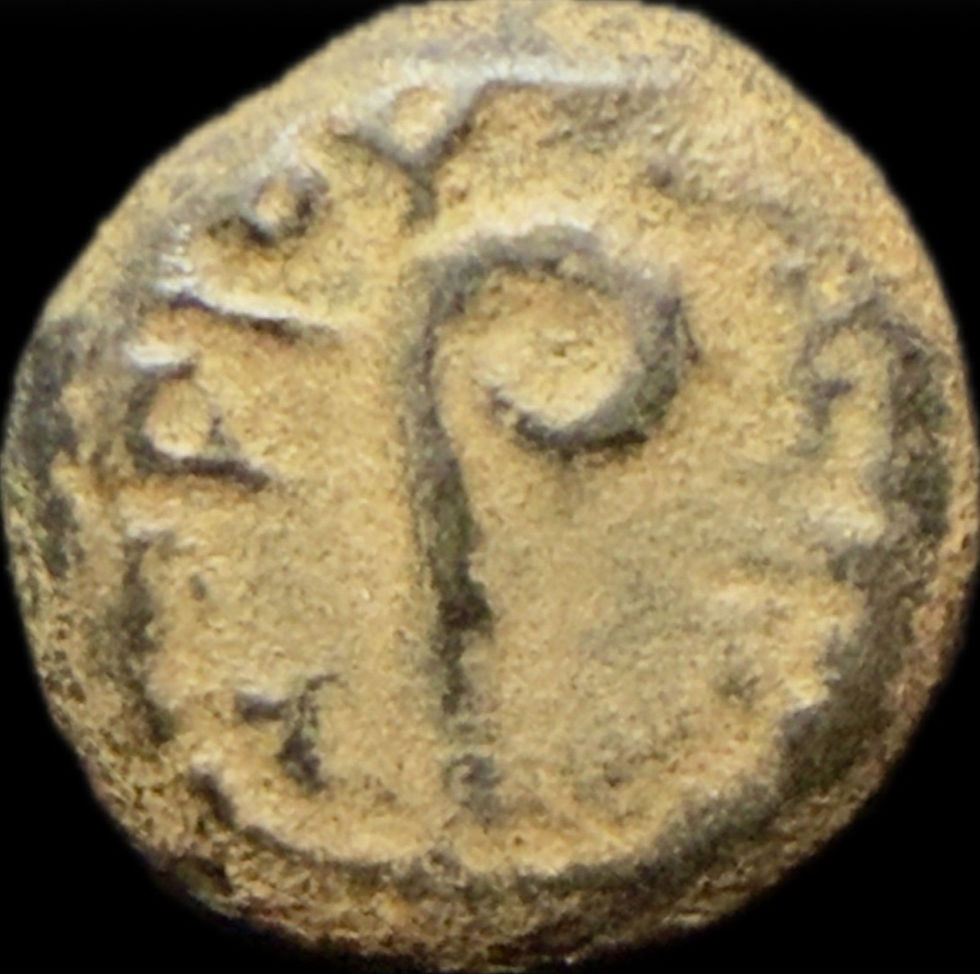
Further confirmation emerges from numismatic evidence visible on the Shroud itself. High-resolution imaging and 3D analysis reveal small, coin-shaped bulges over the eyes of the figure—consistent with the ancient Jewish and Roman custom of placing coins on the eyelids of the deceased to keep them closed. Researchers Alan Whanger, Robert Bucklin, and numismatist Agostino Sferrazza have identified these as 1st-century leptons (small copper coins) minted under Pontius Pilate between 29 and 31 AD. One shows a distinctive lituus (augur’s staff) and partial Greek inscription “TIBERIOU KAICAPOC” (“of Tiberius Caesar”); the other matches the “Julia” lepton series. Computer-enhanced studies confirm 74 points of congruence with known Pilate coins from Jerusalem. No medieval forger could have known or replicated these obscure, tiny coins that circulated only briefly in Judea during Pilate’s governorship—the exact period of Jesus’ crucifixion.
Archaeological finds from the tomb of Caiaphas provide the final, dramatic link. In 1990, Israeli archaeologists uncovered the ornate ossuary of Joseph Caiaphas—the high priest who, according to the Gospels, orchestrated Jesus’ trial and handed him over to Pilate (Matthew 26:57; John 18:24). Inside the tomb and ossuary were two iron crucifixion nails, one bent from striking wood and bearing microscopic traces of bone and wood fragments. Recent petrographic and chemical analysis by geologist Aryeh Shimron (2020) confirms these nails originated in the Caiaphas tomb and were used in a 1st-century crucifixion. Proponents note that the nail dimensions, bending pattern, and wrist-penetration wounds visible on the Shroud perfectly match these artifacts—details unknown to medieval artists, who invariably depicted nails through the palms.


Together, the Jerusalem-specific pollen spectrum tracing the Shroud’s exact historical route, the Pilate coins dating the burial to 29–31 AD, and the matching crucifixion nails from Caiaphas’ tomb form a scientific and historical tapestry that no medieval forgery could possibly replicate. While the 1988 carbon-dating result (1260–1390 AD) has been challenged by evidence of repaired patches and contamination, these independent, multi-disciplinary findings—pollen, coins, and nails—stand unchallenged and collectively confirm what millions have believed for centuries: the Shroud of Turin is the authentic burial cloth of Jesus Christ, bearing silent witness to the central event of Christian faith.
A replica of the Shroud is included in the museum exhibit, as are replicas of the nails, actual Pilate coins, a crucifixion nail, and a Crown of Thorns from Bethlehem.

Comments