

The Younger Dryas: Rapid Oscillations in Earth’s Climate Recovery After the Flood

Secular researchers describe the Younger Dryas as a sudden return to near-glacial cold that interrupted the warming after the peak of the last ice age. In their timeline it spans roughly 12,900 to 11,700 years ago. Ice cores, especially from Greenland, record sharp drops in temperature of several degrees, sometimes occurring in a matter of years or decades. A distinctive dark, organic-rich layer known as the “black mat” appears at many North American sites (and elsewhere) at the onset of this cold interval. Beneath or within that layer researchers have found elevated iridium and platinum, magnetic microspherules, glass spherules, and microscopic hexagonal diamonds (lonsdaleite). These markers have fueled debate about an extraterrestrial impact or airburst.
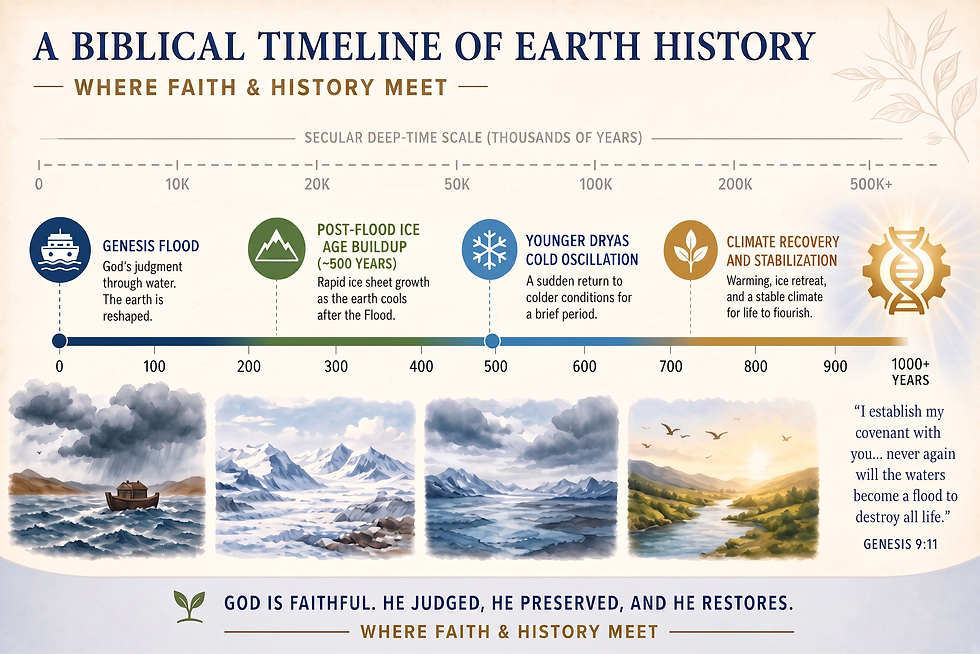
The entire picture changes once we start with Scripture rather than deep-time assumptions. Genesis records a global Flood that completely reworked the surface of the earth only a few thousand years ago. The unique conditions left by that catastrophe produced a single, rapid Ice Age lasting roughly five to seven centuries. The Younger Dryas is simply one of the prominent climate oscillations that occurred while the earth was recovering from those Flood conditions.
The Post-Flood Ice Age and Its Oscillations
After the Flood the oceans were abnormally warm. Heat released from the fountains of the great deep, extensive volcanism, and the formation of new seafloor kept ocean temperatures elevated for centuries. Warm water evaporates far more readily than cold water, so the atmosphere carried enormous amounts of moisture. At the same time residual volcanic aerosols and dust still lingering in the stratosphere cooled the continents during summer, preventing the snow from melting completely each year. The result was rapid buildup of ice sheets in high latitudes and on mountains.

Because the climate system was still highly unstable, the recovery was not smooth. Ice cores reveal a series of abrupt temperature swings. These are real fluctuations produced by the same catastrophic conditions. Fresh meltwater floating on the still-warm ocean surface could temporarily suppress heat exchange. Changes in sea-ice extent, pulses of residual volcanism, and shifts in atmospheric circulation produced the rapid warmings and coolings recorded in the ice. Annual layers in the ice sheets were much thicker early on because of the high precipitation rates, so the entire deep portion of the Greenland ice sheet fits comfortably within a few centuries of intense post-Flood activity followed by the more stable climate of the last four thousand years.
The Younger Dryas itself marks a late-stage oscillation during deglaciation. After a brief warmer interval the climate swung cold again before the final recovery into the present interglacial-like conditions. This cyclical pattern of warming, cooling, and re-warming is exactly what we would expect while the oceans slowly cooled, the volcanic aerosols gradually cleared, and the ice sheets melted in pulses rather than all at once.
The Black Mat and Its Distinctive Markers
Across dozens of sites in North America a dark, carbon-rich “black mat” drapes the landscape that was occupied by Clovis people and the last of the Rancholabrean megafaun (mammoths, mastodons, giant sloths, etc.). The base of this layer coincides with the onset of the cold pulse. It often contains abundant charcoal and other evidence of widespread biomass burning. Directly associated with it are the exotic markers: elevated iridium and platinum, magnetic grains and microspherules, glass spherules, and microscopic hexagonal diamonds.
The Flood was accompanied by the catastrophic disruption of the body we have called Rahab, a large planetary or cometary mass whose tidal shredding and subsequent debris swarm produced the intense late bombardment that formed the large lunar basins and the maria. Residual fragments from that same swarm, or smaller related bolides still crossing Earth’s path in the centuries after the Flood, would naturally deliver extraterrestrial material. Hexagonal diamonds (lonsdaleite) form under the extreme shock pressures of impact. Glass spherules condense from vaporized rock melted at temperatures far above those of ordinary fires or volcanism.
The elevated iridium and other platinum-group elements require careful attention. These elements are often described as “relatively rare” in ordinary surface sediments and crustal rocks. That description applies only to the upper crust. Platinum-group elements are siderophiles (iron-loving) and therefore concentrated deep within planetary bodies, primarily in the core and to a lesser extent in the mantle. The same physical chemistry that makes them scarce at the surface of Earth also concentrates them deep inside any differentiated body the size of Earth or Rahab.
Extreme volcanism is fully capable of bringing such deep material to the surface and dispersing it widely. Large-scale, high-energy volcanic eruptions, especially those involving mantle-derived magmas or explosive events that loft ash and aerosols high into the atmosphere, can transport and distribute elevated concentrations of these elements over broad regions. Post-Flood residual volcanism, already required by the Ice Age model to keep summers cool for centuries, provides exactly this mechanism. The same deep-source enrichment that would have existed inside Rahab before its disruption would therefore also have existed inside Earth. When Flood-related or post-Flood volcanism tapped those reservoirs, the resulting ash and aerosols could deliver iridium, platinum, and related elements without any need for an exclusively extraterrestrial delivery.
Impact debris from the Rahab swarm would of course carry the same suite of siderophile elements, because Rahab, like Earth, would have differentiated and concentrated them in its interior. Yet the presence of elevated platinum-group elements in the black-mat horizon does not by itself demand an exclusively extraterrestrial source. Both terrestrial extreme volcanism and residual Rahab-related impacts remain viable, and both are consistent with the catastrophic conditions that followed the Flood. The hexagonal nanodiamonds and high-temperature glass spherules still point strongly toward impact processes, while the platinum-group signature itself can be supplied by either (or both) of these deep planetary sources.
The widespread burning recorded in the mat itself is consistent with atmospheric dust and soot loading that both cooled the surface and increased the frequency of fires.

Impacts on Human Groups Such as the Clovis Culture
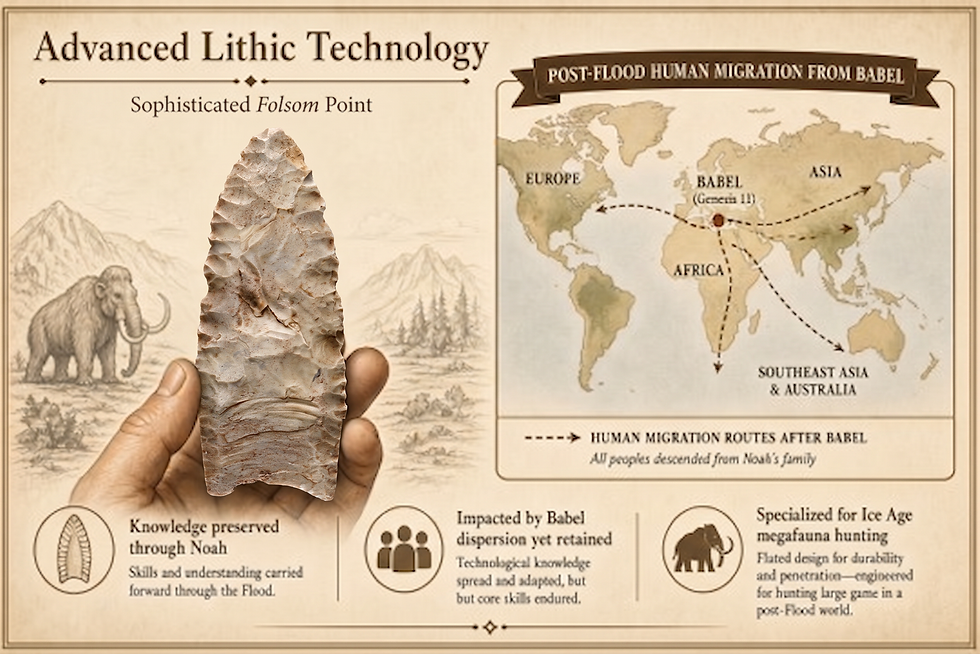
The black mat also marks a clear cultural and ecological boundary for human populations in North America. At numerous classic sites the last in situ Clovis artifacts and the final skeletal remains of many Rancholabrean megafauna (mammoths, mastodons, horses, camels, and others) lie directly beneath or on the surface covered by the black mat. Clovis tools and points are not typically found within or above this layer. Subsequent cultures such as Folsom appear afterward with different tool traditions and a broader resource base.
These Clovis groups were post-Flood, post-Babel descendants who had migrated into North America during the Ice Age. Lowered sea levels from ice-sheet growth created land bridges that allowed both people and animals to spread. Clovis hunters specialized in large game that thrived on the productive mammoth steppe and similar environments while the oceans remained relatively warm and summers stayed cool.
Clovis people are famous for their advanced lithic technology, especially the finely crafted fluted projectile points that required sophisticated knowledge of stone fracture, careful selection of materials, and precise manufacturing techniques. This level of skill is consistent with technology and knowledge that survived the Flood through Noah and his family. After the dispersion and confusion of languages at Babel, such skills were carried by migrating groups and persisted for generations. The rapid climate oscillations of the late Ice Age, combined with residual Rahab-related impacts or airbursts, intensified volcanism, widespread biomass burning, and sudden environmental stress, would have placed severe pressure on these specialized hunter-gatherer groups. Game animals already stressed by shifting vegetation, dust loading, and cooler conditions became scarcer or more unpredictable. Fires and atmospheric changes disrupted local ecosystems. These cumulative shocks during the deglaciation phase help explain the abrupt archaeological disappearance of the distinctive Clovis technocomplex in many regions and the associated megafaunal extinctions. Under such pressures, much of the specialized knowledge and technology was lost or simplified, requiring later reinvention as populations reorganized and adapted. Human populations did not vanish entirely; they continued to spread and fill the earth, just as Scripture indicates after Babel. The black mat simply records a time of significant disruption for particular groups living through the final stages of the post-Flood Ice Age recovery.
Extreme and Catastrophic Climate Shifts
The climate swings of the post-Flood Ice Age were often extreme enough to trap animals in ice while they were still engaged in ordinary activities. Some frozen mammoths and other creatures have been found with undigested or partially digested food still in their mouths or stomachs, or in postures indicating they were foraging or moving when rapidly buried and frozen. These remains point to sudden, catastrophic events rather than gradual cooling over long periods. Dust storms, mudflows, rapid freezes driven by intense cold snaps, or combinations of residual volcanic aerosols and meltwater pulses could quickly entomb animals in frozen ground or ice. Such rapid burial and freezing fit the unstable conditions of the late Ice Age, including the Younger Dryas oscillation, when the climate system was still recovering from the Flood and capable of abrupt, severe changes.

A Cyclical Recovery Consistent with Catastrophe
Uniformitarian models struggle to produce even one ice age with the mechanisms they prefer, let alone the rapid oscillations. The biblical framework supplies both the moisture and the cooling from the outset. Once those conditions began to relax, the climate did not simply trend smoothly warmer. Meltwater pulses, sea-ice expansion and contraction, volcanic pulses, and residual impact debris produced a series of abrupt swings, exactly the pattern preserved in the ice cores and sediment records. The Younger Dryas is the most prominent of those late oscillations, a final cold snap before the earth settled into the more stable climate of the present age.
This recovery process also solves long-standing mysteries. Woolly mammoths thrived on the mammoth steppe while the oceans were still warm and the summers cool; many were buried in the final stages of the Ice Age as conditions shifted. Deserts that are arid today once supported lakes and richer vegetation while the moisture-laden atmosphere still delivered abundant precipitation. All of these features fit a short, intense Ice Age caused by the Flood rather than a long sequence of slow cycles.
Hope Anchored in True History
The same God who judged the earth with a global Flood also preserved Noah and his family and then guided the post-Flood world through its climatic recovery. The rapid oscillations, the black mat, the associated markers, and the stresses experienced by groups such as the Clovis people are not evidence against Scripture. They are further confirmation that the earth’s recent history was shaped by catastrophe on a scale far greater than anything we observe today. When we read the ice cores, the sediment layers, and the archaeological record through the lens of Genesis, the data align with a young earth, a single post-Flood Ice Age, and a climate system still settling after the greatest geological event in history.
We continue to explore these connections because they strengthen faith. The rocks, the ice, the black mat, and the traces of early post-Flood peoples all bear witness to the truth of God’s Word. In a world that often feels unstable, that testimony points us back to the One who holds the earth in His hands and who has promised a final restoration far greater than the recovery that followed the Flood.
“I establish my covenant with you... never again will the waters become a flood to destroy all life.” — Genesis 9:11


Comments