

1808 Thomson Bible
- Dr. Robert L. Wright

- Feb 27
- 5 min read
Updated: Mar 2
A Scholarly Milestone in American Biblical Translation and National Identity
Charles Thomson's 1808 Bible, formally titled The Holy Bible, Containing the Old and New Covenant, Commonly Called the Old and New Testament; Translated from the Greek, represents a landmark achievement in American religious scholarship and publishing. As the first English translation of the Septuagint (the Greek version of the Old Testament) ever produced and the first complete Bible translation published in the United States, it embodies the intersection of revolutionary fervor, intellectual pursuit, and Protestant piety in the early republic. Compiled over nearly two decades by Charles Thomson, the longtime Secretary of the Continental Congress, this four-volume work not only advanced biblical studies but also reflected the founders' deep engagement with Scripture as a moral and civic guide. Printed by Jane Aitken in Philadelphia, it marked the first Bible published by a woman in America, underscoring the era's expanding roles in religious dissemination. While not a direct tool in the Revolution, its creation by a key founder highlights the Bible's enduring influence on American principles of liberty, virtue, and divine providence.
Background on Charles Thomson
Charles Thomson was born on November 29, 1729, in Maghera, County Derry, Ireland, to a Scots-Irish Presbyterian family. Orphaned during his emigration to America in 1739, he arrived in Delaware with his siblings and was educated through the benevolence of local figures, eventually studying at the New London Academy in Pennsylvania under Reverend Francis Alison. Thomson's early career included teaching Latin and Greek at various academies, including the Academy of Philadelphia (precursor to the University of Pennsylvania), where he honed his classical language skills. By the 1750s, he had become a prominent merchant and political activist in Philadelphia, advocating for colonial rights and mediating with Native American tribes, notably during the French and Indian War.
Thomson's political ascent began with his election as Secretary of the First Continental Congress on September 5, 1774—a position he held uninterrupted through the Second Continental Congress and the Congress of the Confederation until 1789. As the sole secretary for 15 years, he meticulously documented proceedings, prepared the Journals of the Continental Congress, and co-signed the first printed Declaration of Independence alongside John Hancock on July 4, 1776. He also co-designed the Great Seal of the United States in 1782 with William Barton, contributing the Latin mottos Annuit cœptis ("He approves our undertakings") and Novus ordo seclorum ("New order of the ages"), drawn from Virgil and reflecting a sense of providential destiny for the new nation. Retiring to his estate, Harriton House, in Bryn Mawr, Pennsylvania, in 1789 at age 60, Thomson devoted the remaining 35 years of his life to scholarly pursuits, including agriculture, beekeeping, and, most notably, biblical translation. His deep faith, rooted in Presbyterianism, drove him to study the Scriptures in their original languages, culminating in his groundbreaking Bible.
Development and Publication of the Thomson Bible
Thomson's translation began in earnest after his retirement, spanning nearly 19 years from 1789 to 1808. Motivated by a desire to access the earliest Christian texts, he focused on the Septuagint—a Greek translation of the Hebrew Old Testament produced by Jewish scholars in Alexandria around 250–150 BCE, which was the version quoted extensively in the New Testament. Thomson became the first person worldwide to translate the Septuagint into English, and his work included a fresh rendering of the Greek New Testament, making it the first American translation of the entire Bible. He consulted original Greek manuscripts and aimed for fidelity to the text, often prioritizing literal accuracy over stylistic elegance.
Published in 1808 by Jane Aitken in Philadelphia, the Bible appeared in four volumes: three for the Old Testament (Septuagint without the Apocrypha) and one for the New Testament. Aitken, who inherited her father Robert Aitken's printing business after his death in 1802, became the first woman to print a Bible in America. Robert Aitken had famously produced the 1782 "Bible of the Revolution," endorsed by Congress. Thomson's edition was limited, with copies now rare; his personal copy with manuscript corrections resides in the Philadelphia Library Company. In 1815, Thomson followed with A Synopsis of the Four Evangelists, a gospel harmony based on his translation, printed by William McCulloch.
Features of the Thomson Bible
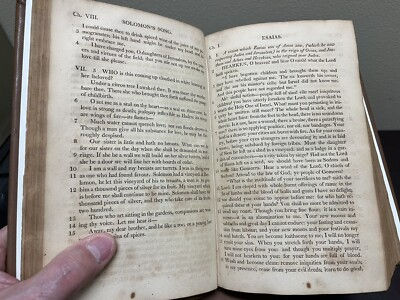
Thomson's translation emphasized scholarly precision, drawing from the oldest available Greek texts to recover "original" meanings. He structured the text in paragraphs based on content rather than traditional verses, with verse numbers in the margins for reference—a format that influenced later modern translations. The language retained heavy echoes of the King James Version (KJV) but introduced clarifications, such as in Exodus 20:1–7, where Thomson sought to convey doctrinal nuances more accurately. Excluding the Apocrypha aligned with Protestant canons, and his New Testament revisions aimed at experiential piety. British scholars praised it for honoring American erudition, though its literal style limited popular appeal.
Role in the Founding of America
While Thomson's Bible was completed post-Revolution, its creator's life and work deeply intertwined with America's founding. As Congress's secretary, Thomson preserved the documentary foundation of the nation, ensuring accurate records of debates on independence, the Articles of Confederation, and the Constitution. His biblical scholarship informed his political philosophy; the Great Seal's mottos evoked scriptural themes of divine favor and renewal, mirroring the founders' view of America as a providentially guided republic. Thomson's translation embodied the Enlightenment-Protestant synthesis among founders like Jefferson and Adams, who saw Scripture as essential to moral governance. In an era when biblical citations dominated political discourse (1760–1805), his work reinforced the idea that liberty required virtuous citizens schooled in ancient texts. By translating the Septuagint—the Bible of early Christians—Thomson linked America's "new order" to Judeo-Christian heritage, symbolizing the nation's self-perception as a modern covenant people.
Importance to American Religious History
Thomson's Bible holds immense significance in American religious history as the first new English Bible translation produced on U.S. soil, predating others by 15 years and setting a precedent for indigenous scholarship. It elevated America's role in global biblical studies, with reprints in England (1904, 1907, 1929) and the U.S. (1954) affirming its enduring value. By making the Septuagint accessible, Thomson facilitated deeper Protestant engagement with early Christian sources, influencing 19th-century revivalism and textual criticism. His work addressed post-Revolutionary Bible shortages, promoting literacy and piety amid denominational growth. As a product of a founder, it exemplifies how religion underpinned national identity, countering secular narratives of the era. Jane Aitken's printing advanced women's involvement in religious publishing, while Thomson's emphasis on original languages foreshadowed modern translations like the Revised Standard Version.
Legacy and Conclusion
Thomson's Bible, though not a bestseller in its time due to its scholarly tone, remains a "monumental achievement" preserved in institutions like The Flood Museum, Museum of the Bible, and Library Company of Philadelphia. Reprints and studies continue to highlight its contributions, reminding us of the founders' blend of faith and reason. Charles Thomson died on August 16, 1824, leaving a legacy that wove biblical scholarship into America's fabric. His work affirms that the nation's founding was not merely political but profoundly spiritual, with Scripture as a guiding light for liberty and learning. This Bible is included in The Flood Museum's Nauvoo Bible Museum exhibit.


Comments