

Dresden Codex

A Preserved Maya Witness to the Global Flood
At The Flood Museum, we celebrate every artifact that echoes the truth of Genesis 6–9: one real, worldwide Flood that judged a wicked world and preserved life through Noah’s obedience. Among the most remarkable confirmations from the ancient Americas is the Dresden Codex—one of only four surviving Maya books. Its dramatic depiction of a catastrophic deluge on page 74 stands as powerful testimony that the Maya people, descendants of those scattered at Babel, carried a memory of the same historical event recorded in the Bible.

The History of the Dresden Codex: Survival Against All Odds
The Dresden Codex is the oldest and best-preserved of the four known Maya codices (the others being the Madrid, Paris, and Grolier). Written in hieroglyphic script on folded bark paper (amate) around the 11th or 12th century AD, it is believed to be a copy of much older material. It contains intricate astronomical tables, eclipse predictions, Venus cycles, ritual almanacs, and mythological scenes—evidence of the Maya’s advanced knowledge of time, the heavens, and their gods.
Its survival is nothing short of miraculous. In the early 16th century, Spanish conquistadors and Catholic missionaries arrived in the Yucatán Peninsula. Convinced that Maya religion was demonic, they systematically destroyed indigenous culture. The most infamous act came in 1562 at the town of Maní, when Bishop Diego de Landa ordered a public auto-da-fé (act of faith). In his own words from Relación de las cosas de Yucatán, he recorded:
“We found a great number of books in these letters, and since they contained nothing but superstitions and falsehoods of the devil we burned them all, which they took most grievously, and which gave them great pain.”
Thousands of codices—perhaps tens of thousands—were consigned to the flames. De Landa and his fellow missionaries viewed the beautiful, painted books as tools of Satan that hindered conversion to Christianity. This religious bias, combined with colonial zeal, nearly erased an entire civilization’s written history. Only four codices escaped destruction, most likely carried to Europe by early Spanish explorers or officials. The Dresden Codex first appeared in Vienna in 1739, was purchased for the Saxon State Library in Dresden, Germany, and was finally identified as a Maya manuscript in 1853. Even then, it survived water damage during the 1945 bombing of Dresden. God sovereignly preserved this ancient witness.
The Flood on Page 74: A Cataclysmic Deluge Remembered
The most striking feature for visitors to The Flood Museum is the full-page scene on page 74. It depicts a terrifying global flood:
A great celestial serpent or crocodile-like creature stretches across the sky, symbolizing the heavens opening.
The old goddess Chak Chel (Ix Chel), the Maya rain and destruction deity, pours torrents of water from an overturned jar. Eclipse glyphs hang above her, signaling cosmic catastrophe.
Below, a black god of the underworld crouches with spears and a sling; a screaming owl perches on his head, a symbol of death and omen.
Water streams from the sky and from the mouths of the gods, flooding the earth. The accompanying glyphs reference the end of a world age and the renewal of creation.
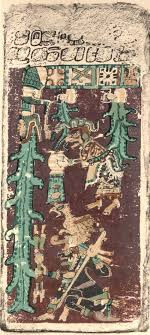
In Maya cosmology, this flood marks the destruction of a previous creation or world age. Their Long Count calendar and creation myths describe successive worlds destroyed by cataclysm—fire, flood, or wind—before the current era. The Dresden flood scene is tied to their 5,125-year cycles and New Year ceremonies symbolizing cosmic rebirth.
Significantly, Bishop de Landa himself recognized the parallel. He explicitly referred to the Maya flood account as “THE flood,” linking it directly to the biblical story of Noah he knew from the Old Testament. Even the Spanish priest, in the midst of his destruction campaign, could not deny the obvious similarity.
A Worldwide Confirmation of Biblical Truth
The Dresden Codex is not an isolated curiosity. It joins hundreds of flood traditions from every continent and culture—Chinese, Babylonian, Greek, Native American, Australian Aboriginal, and African—each preserving memories of a great deluge that destroyed the world and from which only a handful survived. These stories vary in details (as one would expect from oral traditions passed down after the confusion of languages at Babel in Genesis 11), yet they share core elements: universal wickedness, divine judgment by water, a righteous family saved in a vessel, and a new beginning.
The Maya, separated from the Middle East for millennia after Babel, still remembered the event with remarkable clarity. Their codex—written centuries before Columbus—depicts a worldwide watery catastrophe followed by renewal, exactly as Genesis describes the Flood covering “all the high mountains under the entire heavens” (Genesis 7:19) and the subsequent covenant with Noah (Genesis 9:8–17).
Modern scholarship has deciphered the codex and confirmed its flood imagery, while unbiased analysis of global legends demonstrates that such stories cannot be dismissed as coincidence or mere “local flooding.” They are corrupted yet consistent echoes of the one true historical event recorded with perfect accuracy in God’s Word.
A Testimony Preserved for Today
The Dresden Codex stands as a powerful rebuke to those who once tried to erase it. Despite the religious bias and flames of the 16th century, God ensured this ancient book survived to proclaim His truth in our day. Just as the worldwide geological record and the layers of sediment left by Noah’s Flood testify at The Flood Museum, so does this fragile Maya codex.
The God who judged the earth by water in Noah’s day (Genesis 6–9) is the same God who offers salvation today through the finished work of Jesus Christ—our greater Ark. The Dresden Codex invites every visitor to consider: if cultures on opposite sides of the globe independently remembered the Flood, perhaps it really happened exactly as the Bible says.
References
Grondine, E. P. “The Maya Mega-Tsunami Accounts and Dresden Codex Page 74.” Academia.edu, n.d.
Landa, Diego de. Relación de las cosas de Yucatán. Edited and translated by Alfred M. Tozzer. Cambridge, MA: Peabody Museum, 1941.
The Dresden Codex. Saxon State and University Library Dresden (SLUB). Digital facsimile accessed 2026. https://www.slub-dresden.de/en/explore/manuscripts/the-dresden-maya-codex/content.
The Holy Bible, English Standard Version. Wheaton, IL: Crossway, 2001.
Vail, Gabrielle, and Christine Hernández, eds. Astronomers, Scribes, and Priests: Intellectual Interchange between the Northern Maya Lowlands and Highland Mexico in the Late Postclassic Period. Washington, DC: Dumbarton Oaks, 2010.


Comments