

The Aleppo Codex

A Remarkable Guardian of God’s Word in Biblical History
At the Flood Museum, we celebrate the providential preservation of Scripture across the ages. Just as God preserved Noah and his family through the global Flood of judgment (Genesis 6–9), He has faithfully guarded His written Word through centuries of trials, persecutions, and dispersions. One of the most extraordinary witnesses to this divine faithfulness is the Aleppo Codex—known as the “Crown of Aleppo” (Keter Aram Tzovah)—featured in our exhibits. This ancient manuscript stands as a testament to the meticulous care Jewish scribes took to transmit the Hebrew Bible accurately, confirming the reliability of God’s Word from the days of Moses to our own.
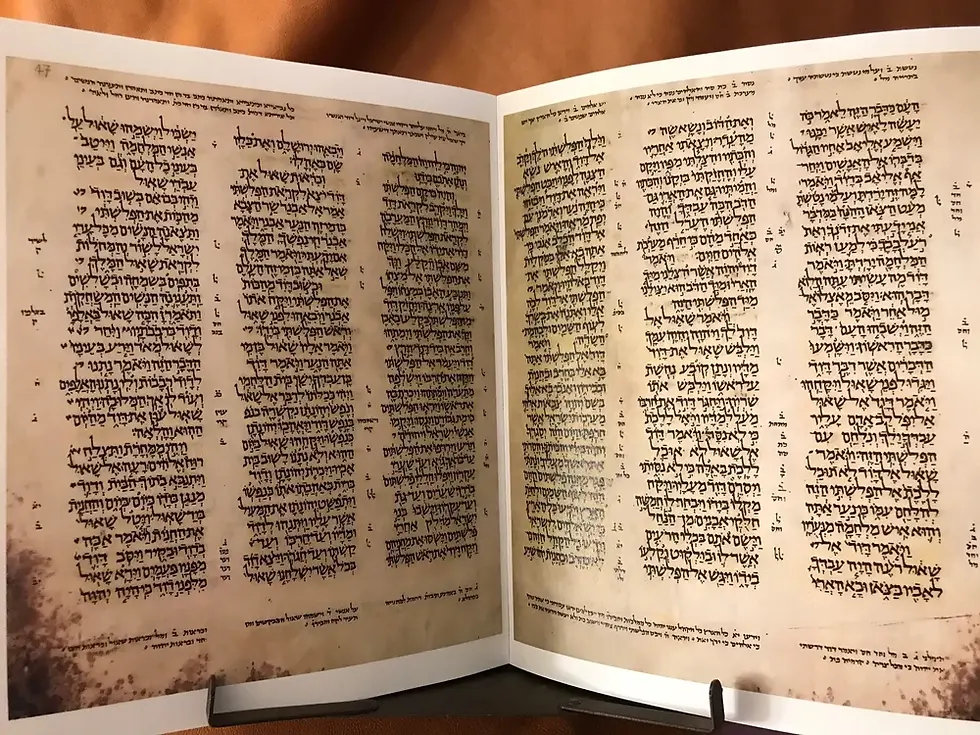
The Aleppo Codex was produced around 930 AD in Tiberias, near the Sea of Galilee, by skilled Masoretic scribes. The Masoretes were a group of dedicated Jewish scholars who, between the 7th and 11th centuries, worked tirelessly to preserve the exact text of the Hebrew Scriptures. They added vowel points (nikkud), cantillation marks (te’amim) for proper chanting, and extensive marginal notes called the Masorah—cross-references and counts ensuring no letter was added or omitted. The Aleppo Codex, likely corrected and annotated by the renowned scribe Aaron ben Asher himself, became the pinnacle of this tradition. It contained the complete Hebrew Bible in 24 books, written on parchment in a bound codex format rather than scrolls.
Its significance in biblical history is immense. The Aleppo Codex was regarded as the most authoritative text of the Masoretic tradition. The great medieval scholar Maimonides (Rambam) declared it the standard by which all other copies should be checked, stating that it had been meticulously corrected by ben Asher over many years. For generations, scribes and communities relied on it to ensure the purity of the biblical text. When compared to earlier witnesses like the Dead Sea Scrolls (dating back over 2,000 years), the Aleppo Codex demonstrates remarkable consistency in the transmission of Scripture—proof that God has preserved His Word through faithful hands, just as He promised: “Heaven and earth shall pass away, but my words shall not pass away” (Matthew 24:35).
The remarkable history of the Aleppo Codex reflects both human devotion and divine protection. After its creation in Tiberias, it journeyed to Jerusalem, where it was likely looted during the Crusader conquest in 1099. Ransomed by the Jewish community in Cairo, Egypt, it was studied there before being transferred to Aleppo, Syria, in the 15th century. For nearly 600 years, the Jewish community in Aleppo guarded it with utmost reverence in the Great Synagogue (also called the Central Synagogue), bringing it out only for scholarly consultation or special occasions. It became a sacred treasure, symbolizing Jewish continuity and fidelity to the Torah amid exile and hardship.
Tragically, in November 1947, following the United Nations vote to partition Palestine and establish the State of Israel, anti-Jewish riots erupted in Aleppo. The Great Synagogue was torched, and the codex was thought to have been destroyed. News of its loss spread worldwide. Yet God’s providence prevailed: remnants of the manuscript survived the violence. In 1958, after a mysterious decade, the surviving portions—smuggled out of Syria—arrived in the newly established State of Israel, presented to President Yitzhak Ben-Zvi. Today, what remains (approximately 294 of an original estimated 487 pages) is housed in the Shrine of the Book at the Israel Museum in Jerusalem, where it is displayed alongside the Dead Sea Scrolls.

About 40% of the codex is missing, including most of the Torah (Pentateuch) except the end of Deuteronomy. Initial assumptions blamed fire damage from the 1947 riots, but careful conservation work revealed that dark marks on the pages were caused by mold and fungus, not charring—suggesting the manuscript may not have been directly burned. The fate of the lost pages remains one of history’s great mysteries, with ongoing speculation and searches. Despite these losses, the surviving sections retain exceptional value for textual criticism and biblical studies.
The Aleppo Codex’s journey—from creation in Tiberias, through ransoms and guardians in Cairo and Aleppo, to survival amid 20th-century turmoil—mirrors the Bible’s own story of preservation through persecution. Just as the Flood destroyed a corrupt world but spared Noah’s family to repopulate the earth, God has used faithful believers across millennia to safeguard His Scriptures. The codex stands as evidence that the Hebrew Bible we read today is faithfully transmitted, not corrupted by time or human error.
At the Flood Museum’s Nauvoo Bible Museum, this exhibit reminds us that God’s Word is eternal and trustworthy. From the cataclysm of Noah’s day to the meticulous work of the Masoretes and the dramatic survival of treasures like the Aleppo Codex, Scripture declares God’s unchanging truth. As 2 Timothy 3:16 affirms, “All scripture is given by inspiration of God.” Come see the displays, study the history, and leave with renewed confidence that the Bible you hold is the same Word God has preserved for His people across the ages. The evidence points to a faithful Creator who judges sin, preserves truth, and offers salvation through Jesus Christ, the living Word.


Comments