

The Bible's Role in American Military History

Updated: Mar 2
The Bible has played a profound and multifaceted role in America's wars, serving not only as a source of spiritual guidance and moral justification but also as a tangible symbol of hope, protection, and national identity for soldiers and sailors. From the founding of the nation through the ideological tensions of the Cold War, the Scriptures have been invoked to rally troops, provide comfort amid the horrors of battle, and frame conflicts as righteous struggles. Organizations like the American Bible Society (ABS) have distributed millions of Bibles to military personnel, often with endorsements from presidents and generals. Soldiers frequently carried pocket editions, believing they offered divine protection—sometimes literally, by stopping bullets. This analysis explores the Bible's influence across key conflicts, with special emphasis on the Heart Shield Bible and its counterparts in earlier wars.
The Revolutionary War (1775–1783): Scriptural Foundations for Independence
During the American Revolution, the Bible was a cornerstone of patriotic rhetoric, used by ministers and leaders to justify rebellion against British rule and inspire courage in the face of overwhelming odds. Colonial preachers, often dubbed the "Black-Robed Regiment," drew on Old Testament narratives to portray the conflict as a holy war. Stories like that of Gideon (Judges 6–8), who led a small force against a superior enemy, or Deborah's song of victory (Judges 5), emphasized themes of divine providence, sacrifice, and militant initiative. As historian James P. Byrd notes, these texts helped overcome soldiers' aversion to killing and framed the Revolution as a defensive struggle blessed by God.
General George Washington exemplified this reliance on faith, frequently invoking Providence in orders and letters. In a 1779 missive, he expressed trust in God's design amid the war's trials. Chaplains played a key role, with over 100 serving in the Continental Army, leading prayers and sermons that bolstered morale. Soldiers carried personal Bibles, such as the one belonging to Francis Merrifield of the Massachusetts militia, inscribed after he survived the Battle of Bunker Hill in 1775. This artifact, now in museum collections, underscores how the Bible provided personal solace during the chaos of combat.

English Bibles were scarce in the colonies until after independence, with most imported from Britain, highlighting the Revolution's role in fostering American biblical printing.
The Bible's influence extended to the war's ideological underpinnings. Loyalists cited Romans 13:1–4 to condemn rebellion, but Patriots reinterpreted it through a republican lens, viewing the fight as self-defense against tyranny. This scriptural debate helped unify the cause, with sermons proving more influential than pamphlets in mobilizing support.
The Civil War (1861–1865): A Divided Nation United by Scripture
The Civil War saw the Bible invoked by both Union and Confederate forces, often to support opposing views on slavery, secession, and divine will. As Abraham Lincoln observed in his Second Inaugural Address, both sides "read the same Bible and pray to the same God," yet interpreted it to claim moral superiority. The ABS distributed over 5 million Scriptures to soldiers on both sides, including pocket New Testaments designed for shirt pockets—earning the nickname "Soldier's Testament." These were sometimes the only reading material available in camps and hospitals.
A notable edition was the Soldier's Pocket Bible, a 1861 reprint of a 1643 version used by Oliver Cromwell's troops during the English Civil War. It featured verses tailored for soldiers, with Cromwell's motto: "Trust in the Lord and keep your powder dry."
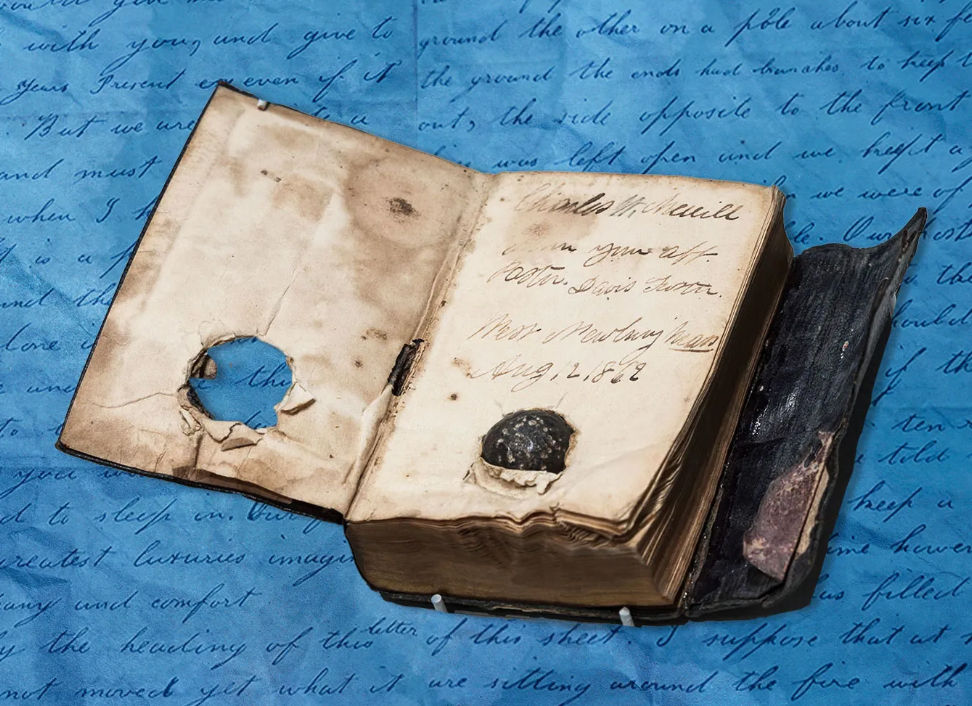
Many soldiers viewed these Bibles as protective talismans; stories abound of them stopping bullets, such as the one carried by Private Walter G. Jones of the 8th New York Cavalry, pierced twice but saving his life at Cedar Creek and Appomattox. The ABS navigated blockades to supply the South, reflecting the Bible's role in transcending division while providing comfort amid the war's staggering 750,000 deaths.
Chaplains and spirituals further amplified the Bible's impact. Enslaved African Americans used songs like "Go Down, Moses" to encode messages of liberation, drawing on Exodus themes. For sailors, Bibles were distributed aboard ships, offering solace during naval blockades and battles.
World War I (1917–1918): Pocket Scriptures for the Trenches
In World War I, the Bible's role expanded with mass distribution efforts. The ABS launched a campaign to provide every U.S. soldier and sailor with a Gospel of John, printing about 6 million copies. President Woodrow Wilson, a Presbyterian elder, wrote prefaces urging troops to find life in the Scriptures. General John J. Pershing also endorsed them, emphasizing moral guidance in battle.
Pocket New Testaments, often issued by the YMCA or with Theodore Roosevelt's note ("This is worth reading, comrade and friend"), were carried as devotionals and amulets. Stories of Bibles stopping bullets persisted, such as one saving a British soldier (though American examples exist too).

For sailors, Navy-specific editions included hymns like "The Star-Spangled Banner." These Scriptures helped troops cope with trench warfare's horrors, reinforcing faith amid the first modern global conflict.
World War II (1941–1945): The Heart Shield Bible and Global Faith
World War II marked a peak in the Bible's protective symbolism, epitomized by the Heart Shield Bible—a metal-plated New Testament designed to fit in a soldier's chest pocket, intended to shield the heart from bullets. President Franklin D. Roosevelt included a personal message: "As Commander-in-Chief, I take pleasure in commending the reading of the Bible to all who serve in the armed forces." Millions were distributed, often as war bond purchases sent by families. Inscriptions like "May God Bless You" or "May This Keep You Safe From Harm" personalized them.

Numerous accounts detail these Bibles saving lives, such as Lieutenant John Phillips', pierced by a bullet in Europe. ABS and Gideons supplied Scriptures to troops worldwide, including Jewish editions for Jewish soldiers. For sailors, similar pocket Bibles provided comfort during naval campaigns. The war's scale amplified the Bible's role in sustaining morale against Axis powers.
The Vietnam War (1955–1975): Personal Faith Amid Controversy
In Vietnam, the Bible offered solace in a divisive conflict. ABS distributed 18.5 million Scriptures from 1966–1972. Soldiers carried pocket Bibles, with remarkable stories like one shared by seven veterans across 11 tours, providing spiritual continuity.

Clarence Singleton's bloodstained Bible, carried with the Marines, symbolizes faith's endurance. Chaplains used Scriptures for prayers over the fallen, while indigenous groups like the Koho received translations amid the war, fostering Christianity. The Vietnam Veterans' Bible, published post-war, included veterans' testimonies of healing through faith.
The Cold War (1947–1991): Ideological Battle and Spiritual Resilience
The Cold War, an era of proxy conflicts and nuclear tension, saw the Bible frame the ideological struggle against communism as spiritual warfare. Analogies to Ephesians 6:12 ("principalities...spiritual wickedness") portrayed it as a battle for souls. ABS continued distributions, including during Korea and Gulf War buildups. Military heritage emphasized biblical faith, with presidents like Eisenhower promoting "In God We Trust" amid anti-atheist sentiments. For soldiers in hotspots like Berlin or submarines, Bibles provided comfort in a war of attrition.
Conclusion: A Legacy of Faith and Fortitude
Across America's wars, the Bible has been more than a book—it has been a beacon of hope, a moral compass, and occasionally a literal lifesaver. From Revolutionary sermons to Cold War resilience, it has shaped soldiers' and sailors' experiences, reflecting the nation's Judeo-Christian roots. While interpretations varied, its presence underscores faith's role in enduring conflict's trials. Today, this legacy continues in military chaplaincy and Scripture distributions, reminding us of the human cost of war and the search for divine meaning within it. These Bibles are included in The Flood Museum's Nauvoo Bible Museum exhibit.


Comments