

The Eternal Name: Yahweh’s Witnesses from the Desert to Today

In a world overflowing with headlines of chaos, forgotten empires, and gods that have vanished from memory, Scripture still stands. Exodus 3:15 records the moment God revealed His name to Moses at the burning bush: “This is my name forever, the name you shall call me from generation to generation.” Yahweh. Not a title that shifts with cultures, but the personal, covenant name that would endure. The question is not merely whether the Bible claims this. The question is whether the stones, the metal, and the manuscripts still speak it.
They do. Five lines of evidence, stretching from the late 15th century BC to the printed page in a modern Jewish home, confirm that the name has not been erased. These finds sit comfortably alongside exhibits already gathered at The Flood Museum, where Egyptian records, inscribed stones, and memorial objects are read without the assumptions of deep time. They belong to the same post-Flood world in which God reset the earth, scattered the nations at Babel, raised up Egypt, and then called a people by His own name.
The Soleb Inscription: Yahweh Known in Egypt
At Soleb in what is now Sudan, Pharaoh Amenhotep III built a temple to Amun-Ra. On one of its columns, among lists of conquered or subdued peoples, appears a hieroglyphic phrase: the land of the Shasu (nomads) of Yahweh. The signs are clear enough—the reeds, the house, the quail chick, the vulture—that they spell the divine name. The inscription dates to the late 15th century BC, the very window in which a straightforward reading of 1 Kings 6:1 places the Exodus.
This is not an Israelite text. It is an Egyptian official record. It shows that the name Yahweh was already attached to a people living as nomads, known to the greatest power of the day. The Flood Museum’s “Egypt in God’s Plan” exhibit already traces how Egypt’s monuments, Nile rhythms, and historical lists fit a young-earth timeline shaped by Creation, the Flood, and rapid post-Flood adaptation. Soleb belongs in that conversation. It is one more Egyptian witness that the God who judged the world with water and then preserved a remnant was not invented later. His name was already on the lips of the people He was about to redeem.

The Moabite Stone: A Rival King Speaks the Name
Nine centuries later, King Mesha of Moab commissioned a basalt stele. It now stands in the Louvre. In it he boasts that Chemosh, his own god, had been angry and allowed Israel to oppress Moab, but then Chemosh returned and gave victory. Mesha records taking “the vessels of Yahweh” from an Israelite city and dragging them before Chemosh.
The stone is a pagan victory monument. It treats Yahweh as the God of Israel, distinct from Chemosh. It names Omri’s house and describes events that parallel 2 Kings 3. The language is close to biblical Hebrew. Here is a 9th-century BC enemy of Israel inadvertently confirming both the existence of the nation and the name of its God.
Inscribed stones and tablets already appear among the Museum’s artifacts—the Pyrgi gold tablets, the memorial stones of the high priest’s breastplate, even the broader category of objects that carry names and tribes before God. The Moabite Stone is another such witness: a rival’s own words preserving what God said would never be forgotten.

The Ketef Hinnom Scrolls: The Oldest Biblical Text
Southwest of Jerusalem, in a tomb complex dated to the late 7th century BC, two tiny silver scrolls were found. When unrolled, they contain the priestly blessing of Numbers 6:24–26: “The Lord bless you and keep you; the Lord make his face shine upon you…” The divine name appears. These are the earliest known copies of a biblical text. They were worn as amulets. People in Josiah’s day, or shortly before the exile, were already carrying Yahweh’s words on their persons. These silver slips are portable memorials of the same Name.

The Dead Sea Scrolls and the Unbroken Line
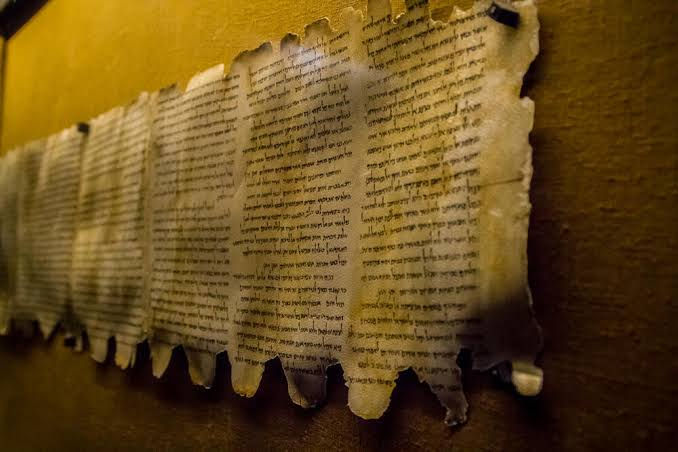
From the 3rd century BC through the 1st century AD, the Qumran caves yielded manuscripts in which the four letters of the Name appear hundreds of times, often in the older paleo-Hebrew script even when the surrounding text is square Aramaic. The scribes treated it with special care. Then, in the printed Tanakh of today—the Stone Edition, the JPS—the same four letters still stand in Exodus 3. The chain is visible.
Pagan deities mentioned on the same artifacts, Chemosh on the Moabite Stone, the gods of Egypt, Assyria, Babylon, have no living worshipers who still write their names as a living confession. Yahweh does.
The God Who Saves
The same Name that was spoken to Moses, recorded by Egyptians, grudgingly acknowledged by Moabites, worn on silver, copied in caves, and printed in modern Bibles is the Name that means “He saves.” Yeshua, Jesus, is Yahweh who came to save His people from their sins. The God who sat enthroned at the Flood (Psalm 29:10), who judged and then covenanted, who brought Israel out of Egypt, who toppled Sennacherib’s army, is the same God who still keeps His Name.
In a world that forgets its gods, the Name remains. That is not merely archaeology. It is hope.


Comments