

The Moabite Stone (Mesha Stele)

A 9th-Century BC Witness to Israel, Yahweh, and Biblical History
At The Flood Museum we highlight ancient artifacts that connect us to the reliable record of Scripture. One of the most compelling is the Moabite Stone, also called the Mesha Stele—a black basalt monument inscribed around 840 BC by King Mesha of Moab. Standing nearly 4 feet tall, this victory inscription provides one of the clearest extra-biblical confirmations of people, places, events, and even the name of God as recorded in the Bible.

Discovery and Remarkable History
In 1868, Anglican missionary F.A. Klein discovered the stele in the ruins of ancient Dibon (modern Dhiban, Jordan), about 20 miles east of the Dead Sea. The Bedouin locals, recognizing its value, tried to sell it, but when negotiations stalled, they heated the stone and doused it with cold water, shattering it into fragments. Thankfully, a paper "squeeze" (impression) had been made beforehand, enabling scholars to reconstruct almost the full 34-line text. The restored pieces are now displayed in the Louvre Museum in Paris.
The inscription is written in Moabite—a language very close to biblical Hebrew—using a script similar to Paleo-Hebrew. It was erected in a sanctuary to commemorate Mesha's victories and to honor his god Chemosh.
What the Inscription Records
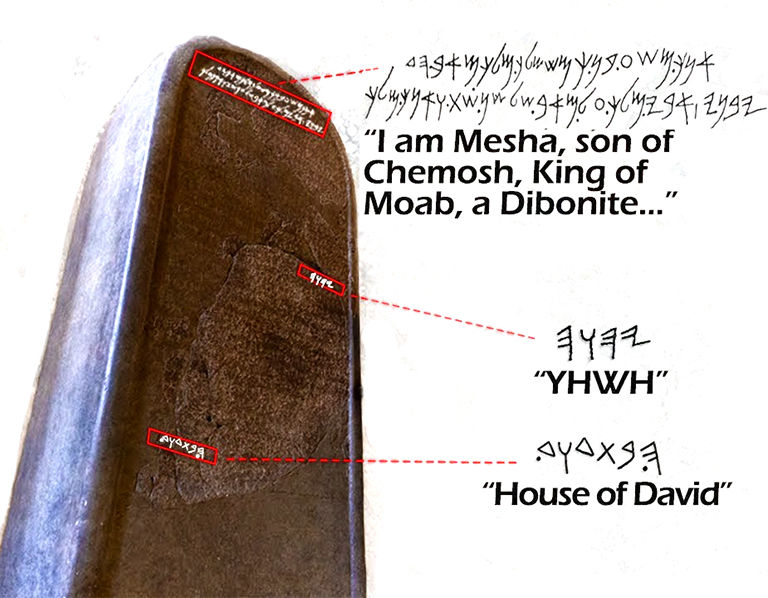
Mesha begins: "I am Mesha, son of Chemosh[yat], king of Moab, the Dibonite." He describes how Chemosh was angry with Moab, allowing Israel—under King Omri and his son—to subjugate them for many years. Mesha then boasts of his successful rebellion, reclaiming territories like Medeba, Ataroth, and Nebo.
A pivotal line reads: "And I took from there the altar-hearths of Yahweh, and I dragged them before Chemosh" (lines 17–18). This marks the earliest certain extra-biblical reference to Yahweh (YHWH), the personal name of the God of Israel. The stele also mentions Israel multiple times and the "House of Omri," confirming Israel's existence as a kingdom with a ruling dynasty in the 9th century BCE.
Direct Parallels to 2 Kings 3
The Bible records the same conflict from Israel's side: "Moab had been subject to Israel. But after Ahab died, the king of Moab rebelled against the king of Israel" (2 Kings 3:4–5).
Mesha was a sheep breeder required to deliver tribute (lambs and wool) to Israel. The stele and Scripture align on:
Omri's dynasty oppressing Moab
Mesha's revolt after Ahab's death
Battles over Transjordan towns
Though perspectives differ (Moabite victory boast vs. biblical narrative), the core historical details match remarkably.
Significance and Implications for Biblical History
The Mesha Stele delivers powerful evidence supporting Scripture's reliability:
It provides the earliest extra-biblical mention of Israel by name (as the "House of Omri").
It contains the earliest confirmed reference to Yahweh outside the Bible.
It verifies the kingdom of Israel as a real, influential power in the 9th century BCE—precisely as described in Kings.
These details counter claims that biblical accounts of the divided monarchy are later myths. Instead, they show the biblical writers recorded accurate history. The inscription also reflects the ancient worldview: nations credited victories to their gods (Chemosh for Moab, Yahweh for Israel), mirroring the theological framework in Scripture.
A Tangible Link at The Flood Museum
The Moabite Stone bridges the ancient Near East to the biblical world, showing real nations, kings, and the God of Israel interacting in history. In a world shaped by the Flood and its aftermath, this artifact affirms that Scripture's record is grounded in verifiable events and places.
Explore more confirming treasures at The Flood Museum. The Moabite Stone endures as proof: the Bible's accounts of Israel, its kings, and Yahweh are rooted in real history.


Comments