

Who's Related to Who?

One of our most thought-provoking exhibits at The Flood Museum invites visitors to stand before five skulls displayed side by side: a modern European human, an Australian Aborigine who died in 1960, a Neanderthal, the famous “Lucy” (Australopithecus afarensis), and a modern chimpanzee. The title asks a simple question with profound implications: Who’s related to who?

Secular museums and textbooks often present a neat evolutionary ladder rising from ape-like creatures to modern humans over millions of years. Yet when these skulls are examined honestly and placed in direct context with one another, without artistic enhancements, selective framing, or decontextualized displays, the story they tell aligns with Scripture, not speculation. Misrepresentations of supposed “human ancestors” like Lucy frequently fail to show them next to both modern humans and apes precisely because the relationship is obvious: Lucy belongs with the apes. Meanwhile, Neanderthals, Australian Aborigines, and other so-called “primitive” human fossils are fully human, every bit as much as you or I. Anatomy, genetics, archaeology, and behavior all point in the same direction.
The Modern European Human Skull: Our Baseline
A typical modern European human skull shows a high, rounded cranium with an average brain capacity of about 1,350 cubic centimeters (ranging 1,200 to 1,500+ cc across populations), a relatively flat forehead, modest brow ridges, a prominent chin, and an orthognathic (flat) facial profile. These features reflect the intelligence, creativity, abstract reasoning, moral capacity, and spiritual awareness God placed in humanity when He created us in His image (Genesis 1:26-27). All living humans today share this basic design, with natural variations arising from genetics, environment, founder effects, and post-Flood diversification after Babel (Genesis 11).

The Australian Aborigine Skull: Looks Can Deceive
The skull of an Australian Aborigine who died in 1960 often displays more robust features, prominent brow ridges, a receding forehead in some individuals, and stronger jaw structure. To eyes trained by evolutionary assumptions, these traits can appear “primitive.”
Yet this individual was fully human in every biblical and scientific sense. He or she possessed complex language, intricate social structures, rich spiritual traditions, artistic expression (including rock art and storytelling), and the full range of human emotions and intellect. Aboriginal Australians developed sophisticated ecological knowledge, astronomical observations, navigation across vast distances, and sustainable land management over generations in one of the world’s most challenging environments. Genetic studies confirm they are modern Homo sapiens, part of the single human family descended from Adam and Eve and, later, from Noah’s family. Comprehensive analyses of mitochondrial DNA and Y-chromosome markers show deep but fully human lineages consistent with post-Babel migrations and long-term isolation, accompanied by genetic drift and localized adaptations, not a separate evolutionary stage.
Looks do not tell the whole story. Evolutionist anthropology in the 19th and early 20th centuries often ranked human populations on an imaginary ladder of progress, placing Aboriginal people near the bottom to justify racist ideologies and colonial policies. Modern genetics and anthropology reject such hierarchies. Cranial robusticity in some ancient and recent Australian populations reflects normal human variation, founder effects, and adaptation in isolated groups. The Bible directly contradicts evolutionary ranking: God “hath made of one blood all nations of men for to dwell on all the face of the earth” (Acts 17:26). All humans, regardless of cranial robusticity, skin tone, or geographic origin, bear God’s image equally and possess equal dignity and eternal worth.
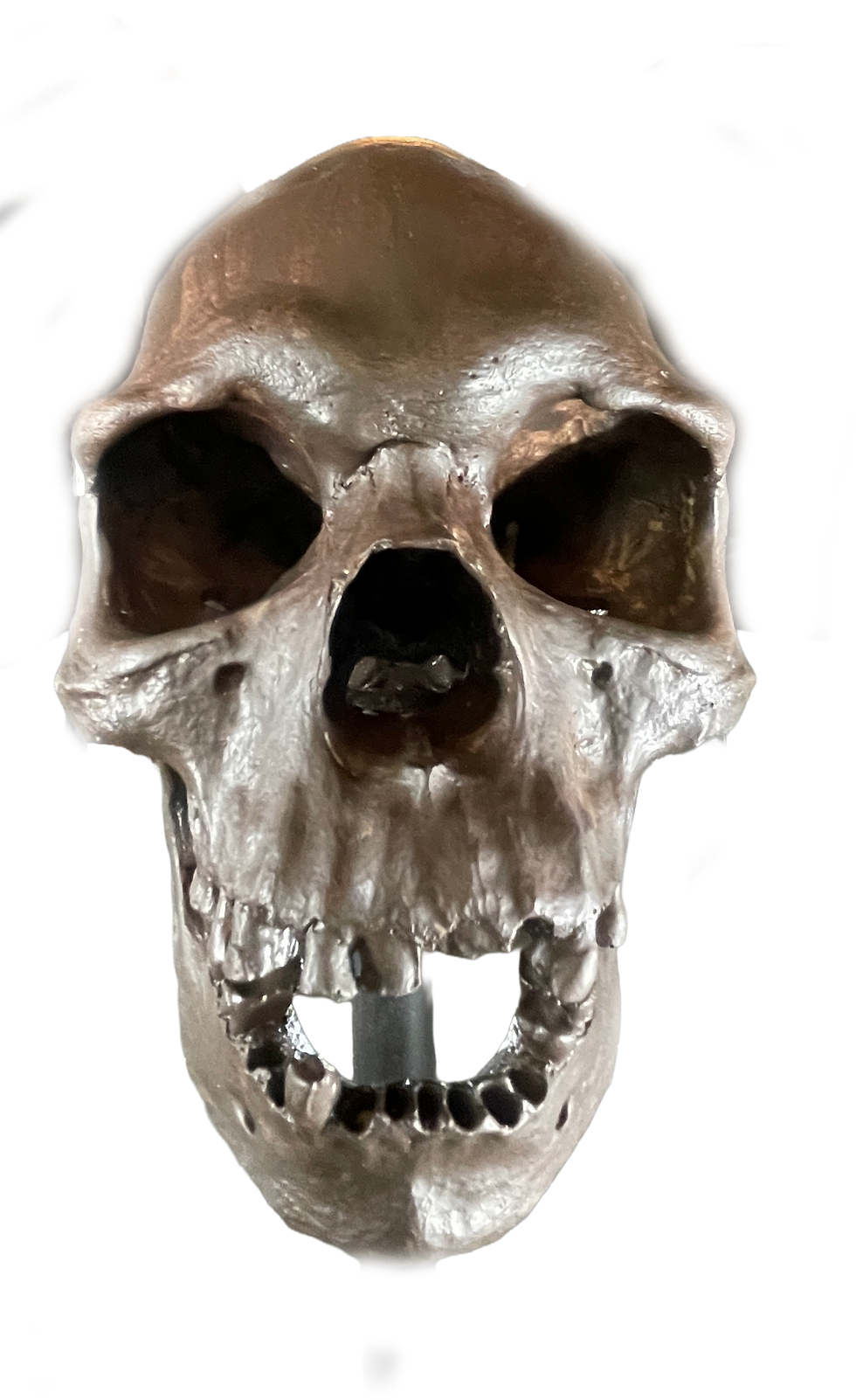
The Neanderthal Skull: Fully Human, Not a Missing Link
Neanderthal skulls are robust, with heavy brow ridges (supraorbital torus), an occipital bun at the back of the cranium, a large nasal cavity (possibly an adaptation for warming and humidifying cold air), and a somewhat projecting mid-face. Average brain capacity often exceeded that of modern humans, around 1,450 cc or more in many specimens, with some reaching 1,600+ cc.
For decades, popular depictions showed Neanderthals as stooped, dim-witted brutes barely capable of speech or culture. Better evidence has overturned this caricature. Neanderthals walked fully upright with a striding gait. They buried their dead, sometimes with possible grave goods or flowers (as at Shanidar Cave in Iraq). They used sophisticated Mousterian stone tools, created personal ornaments and possible symbolic art (including pigment use and engraved objects), made string and fiber artifacts, cared for the sick and injured (evidenced by healed fractures in elderly individuals), and possessed the anatomical structures (including a hyoid bone similar to ours and versions of the FOXP2 gene associated with language) for complex speech.
Most telling from a genetic standpoint: modern non-African humans carry approximately 1 to 4 percent Neanderthal DNA from ancient interbreeding events, primarily estimated around 50,000 to 60,000 years ago. Studies of ancient DNA, including landmark work sequencing the Neanderthal genome, confirm that these encounters produced fertile offspring who contributed lasting genetic material to descendant populations. This is no more unusual or evolutionarily significant than finding Native American, German, Middle Eastern, East Asian, or Sub-Saharan African ancestry markers in a modern DNA test. These percentages and labels are analytical constructs scientists apply to clusters of human genetic variation to trace migrations and admixture within the one human family. They are routinely misused to imply deep evolutionary divergence or “archaic” status when they actually demonstrate the rich genetic diversity God built into humanity and the reality of post-Flood and post-Babel mixing among fully human groups.
Adam was the first man, created directly by God. There is no biblical or scientific necessity to insert pre-Adamic or sub-human ancestors.

“Lucy”: An Ape, Not an Ancestor
The skull attributed to “Lucy” (Australopithecus afarensis), reconstructed from partial fragments discovered by Donald Johanson in Ethiopia’s Hadar region in 1974, tells a very different story. Brain capacity was only about 400 to 500 cc, squarely in chimpanzee range (typically 300 to 500 cc), not human. The face is markedly prognathic (projecting), with large teeth, no chin, and a low forehead. The partial skeleton (roughly 40 percent complete but scattered over a distance of more than a kilometer and across different sediment layers) shows curved fingers and toes well-suited for arboreal (tree-climbing) locomotion, not obligate terrestrial bipedalism.
Evolutionists have long promoted Lucy as a human ancestor or “transitional form,” but detailed anatomical study reveals an extinct ape. The late British zoologist Solly Zuckerman, after years of rigorous comparative analysis, concluded: “They are just apes. Not one of its ape-shaped bones was shaped exactly like the corresponding bone in a human body.” Other researchers have noted that Australopithecus was “far more ape-like in many of its features than we’d ever dared imagine previously.”
Misrepresentations are common in textbooks and museum displays. Reconstructions frequently add human-like posture, reduced body hair, lighter skin, and thoughtful facial expressions. The pelvis was crushed and fragmented. Later reconstructions (notably by Owen Lovejoy) added plaster and assumptions to produce a more human-like short, bowl-shaped pelvis oriented for upright walking. A knee joint often cited for bipedalism was found hundreds of feet away and kilometers distant in different sediments. One vertebra long included with Lucy specimens has been identified by some as belonging to an extinct baboon (Theropithecus). The famous Laetoli footprints, sometimes attributed to Australopithecus, show a human-like gait that some anatomists argue fits modern human feet better than ape-like ones.
When Lucy’s skull (and the associated skeletal elements) is placed directly beside a chimpanzee skull, the similarity is striking. When placed beside a modern human skull, the difference is equally glaring. Displays often avoid this direct, honest, side-by-side comparison, showing Lucy in a progressive “family tree” lineup with humans or artistically enhanced, because the relationship to apes is obvious and undermines the “human ancestor” claim. Lucy was an ape kind, created on Day 6 alongside other land animals (Genesis 1:24-25) and later buried rapidly in the catastrophic sediments of the global Flood. She is not our relative and provides no evidence for human evolution.

The Chimpanzee Skull: Clearly an Ape
A modern chimpanzee skull has a brain capacity of roughly 400 cc, massive brow ridges, a sloping muzzle, large canines, and no chin, unmistakably designed for an arboreal, frugivorous lifestyle with powerful jaw muscles. While chimpanzees display remarkable problem-solving and social intelligence within their created kind, they lack the capacity for abstract reasoning, moral accountability, complex symbolic language, cumulative culture, or worship. Genetic comparisons often cite 98 to 99 percent similarity, but this figure is misleading. It masks major differences in gene regulation, chromosome structure (including the fusion that created human chromosome 2), endogenous retrovirus patterns, and information content that produce vast phenotypic gaps. Chimpanzees were made by God but were never intended to become human.

The Obvious Truth When Skulls Are Compared Honestly
Side-by-side, the five skulls reveal two clear groups with no gradual continuum:
Fully human variations: Modern European, Australian Aborigine (1960), and Neanderthal. Differences reflect genetic diversity within the human kind, environmental adaptations (including possible post-Flood Ice Age conditions for Neanderthals), founder effects, and minor degenerative changes since the Fall. All share the same fundamental design, the same blood, and the same Creator. Archaeological and genetic evidence shows these populations engaged in complex behavior, tool use, art, burial, care for others, and interbreeding, hallmarks of full humanity.
Apes: Lucy and the chimpanzee. Their anatomical relationship is obvious and close when honestly compared. Neither has any demonstrated anatomical, genetic, or behavioral pathway into humanity. The fossil record as a whole shows humans appearing suddenly as fully formed Homo sapiens (or close variants) without a clear, gradual series of ape-to-human transitions. Candidates repeatedly promoted as “missing links” consistently fail under direct scrutiny.
Evolutionary storytelling requires decontextualized displays, heavy artistic imagination in reconstructions, manipulated historical images (such as Haeckel’s fraudulent embryo drawings that still influence some educational materials), and the suppression of contradictory evidence. It requires faith in deep time and unguided processes that neither Scripture nor observable science supports. God’s Word states plainly that man was created fully formed in God’s image on Day 6, that death and suffering entered the world through Adam’s sin (Romans 5:12), and that all humanity descends from that first couple and later from Noah’s family after the global Flood.
The skulls at our exhibit do not show a chain of ancestors climbing toward humanity. They show the handiwork of a Creator who made distinct kinds, endowed humanity with unique dignity and capacities, and allowed rich variation and rapid adaptation within those kinds after the Fall, the Flood, and the dispersion at Babel. They also remind us of our shared need for redemption. The same God who formed Adam from the dust sent His Son, the last Adam, to rescue fallen image-bearers from every tribe and tongue, including all the populations represented in these skulls and their descendants.
See the skulls for yourself. Look closely. Ask the honest question: Who’s really related to who? The evidence from anatomy, genetics, archaeology, and behavior, when freed from anti-God presuppositions, points back to the opening chapters of Genesis and forward to the living hope we have in Jesus Christ.
(For further study, see our related articles on the Lucy fossil, adaptation within created kinds, and human origins from a biblical creation perspective, along with resources from other Christian creation science organizations.)


Comments